





















Care to comment on "Citizen Responsibility?" Let Us Know!
Responsibility
The largest problem in America today is the complete refusal of the majority of
Citizens to accept responsibility for themselves, their actions, their children,
their parents, their... anything! In the "entitlement" society that has emerged
today, everything that goes wrong, and everything that is not right with your
life is "somebody else's fault."
If I spill hot coffee on myself, is it my fault that I got burned?
- No! It's the fault of the evil person who sold/gave it to me and allowed me to spill it on myself.
If I rent a movie from the video store and fail to bring it back, am I responsible for the late fees and cost of the movie replacement?
- No! It's the fault of the evil video store - who already charges too much - for not tracking me down and reminding me to bring the movie back.
If I charge too much on my credit card and find that I can't pay the interest charges, much less the principle, is it my fault?
- No! It's the fault of the evil credit card company who gave me the opportunity (and trusted me to honor my commitments) to have more and live better than I had any business doing so. Not to mention my evil employer who refuses to pay me enough so that I can afford whatever I want.
If my kid is uncontrollable and refuses to act in an acceptable manner, is it my fault?
- No! It's society's fault for not helping me teach/control my child. After all, it takes a village, you know.
If my senior-citizen parents are unable to take care of themselves in their old age, is it my responsibility?
- No! The government is supposed to take care of them. That's what Social Security, Medicare and Medicaid are for.
If my neighborhood is trashed and riddled with crime, is that my fault?
- No! The police and the city are supposed to take care of that. Besides, if my stupid employer would pay me what I am worth, I could move out of this dump and into a better neighborhood.
If I go hiking and I am attacked by a mountain lion, is it my fault if I am horribly disfigured or killed?
- No! It's the evil Park Service, the Forest Rangers, or the Bureau of Land Management's fault for not tagging and monitoring the lion or providing an escort for me.
If I build a house on the Gulf of Mexico and a hurricane wipes it out, along with my family (who didn't evacuate when warned of the storm), is it my fault?
- No! It's the government's fault for not really, really warning me, forcing me to evacuate, saving me and my family or for letting me build and live there in the first place.
You know, the list could go on and on. The excuses are endless. The crux of the
matter is that hardly anyone wants to accept responsibility for their circumstances or
actions. It's always somebody else's fault, somebody else's responsibility.
Self-Respect & Self-Responsibility
Being responsible begins with respect. You must respect
yourself enough to conduct your life in a manner that will always ensure
that your self-respect remains intact. Self-respect is the glue that holds the
individual together. If you have no self-respect, you will not even
understand self-responsibility, much less practice it.
If you refuse to accept responsibility
for yourself, there is little hope that you will ever accept responsibility
for anything else. It is a vicious downward spiral from there. Everything and
everyone you come in contact with will be affected by your failure to accept self
responsibility.
Self-responsibility is what sustains the individual and holds the group
together. Self-responsibility demands that every decision you make and every
action you take is in your own best interest, not with a view towards selfish
desires but from the standpoint of self-respect. What is good for your
self-respect is often uncomfortable, but it is always the right thing to do.
Always striving to do what is right, as opposed to what is expedient,
comfortable, or merely acceptable, is the only way to keep from chipping away at
your own self-respect. There will be times when others want you to do something
that is not in your own best interest - something that is wrong. They won't like
it when you tell them "no" and they may make you pay for your steadfastness in
many different ways. But you have to consider the effect of your actions on
yourself - as well as upon others.
Right is right and wrong is wrong. Despite what those who have little or no
self-respect may tell you, there is no "grey area."
There can
be no compromise between right and wrong, regardless of the degree. When you
compromise your self-respect, you compromise yourself. A little wrong is
still wrong, and you will always pay more for wrong
action than you ever will for right action. Even when "no one is looking," when
what you are tempted to do, or others want you to do "won't hurt anyone," you
have to remember that, if it is wrong, it will still hurt at least one person -
you. You cannot lie to yourself, no matter how hard you might try, if you know
or believe something to be wrong and you do it anyway, it is going to affect how
you view yourself whether it affects anyone else or not.
This does not mean that you will not (or cannot) make mistakes. Mistakes and
errors in judgment are going to happen. But if you always strive first to do
what is right, when the time comes that you do make a mistake, you will be able
to honestly say to yourself and others that you tried to do the right thing,
failed, and are willing to do what it takes to correct the error. No one can
reasonably find fault with that (though many will) and, most importantly you
will not bear the additional burden of knowing you willingly did what you knew
was wrong and that it ended badly.
Right-thinking folks, those who have their own self-respect and know the burden
and joy of self-responsibility, will recognize the same in you, as you will in
them. When you make an honest mistake, they won't hold it against you and will
likely stand with you to correct it. Because you always try to do what is right,
when they are in need you will rush to their aid and when you are in need they
will come to yours. This is how self-respect and self-responsibility helps to
hold a group together - starting with the family, expanding to friends and
ultimately to complete strangers.
Doing what is right is always inclusive, when it comes to others, and never
exclusive. It builds your self-respect, encourages respect for others and brings
the respect of others to you. It can change the world by changing the way people
feel about themselves... but it cannot be faked. If a person has no
self-respect, they will not gain the respect of others no matter how rich or
beautiful or powerful or glamorous they may appear to be. At best, all they will
ever receive is envy, jealousy, fear and, in the end, pity.
Respect for others is what sustains the group and holds a community together. If
you have respect for others it means you will always try to do what is right
concerning your interaction with them - even if that means ending their
miserable existence. You won't cheat them, you won't lie to them, and you won't
attempt to force them to your will. If they refuse to act rightly, you deal with
them in a fair and just manner. Knowing this, others will respect you and want
to interact with you in the same manner. They will feel comfortable and
confident in all their dealings with you. They will know that an honest mistake,
on their part, will not be held against them and that they will always be able
to count on your support.
Just think of the effect such an attitude by others towards you, your family,
your group, might garner. Those who wish to be dealt with fairly will prefer to
deal with you over those with whom they may have their doubts. Those who wish to
deal in deception or other nefarious actions will not fully trust their ability to scam
you.
Doing what is
right, beginning with self respect and ending with respect for others is a
shield, of sorts, which protects you from all manner of harm. It won't stop a
concerted attack by evil, but will protect and prevent all but the most
determined.
Most people succumb to evil through their own actions. Usually through lust
and/or greed, but often through jealousy and anger. The right thinking of
self-respect is the only shield an individual has when
confronted with these emotions.
The "Personal" Responsibilities of a Citizen
The first responsibility of a Citizen is
SELF-RESPONSIBILITY.
YOU are responsible for your hygiene, your health, your actions and
inaction, and the result of those actions or inaction. When you delegate your
self-responsibility to others, you voluntarily relinquish your rights.
Everything else flows from this basic concept.
Once you relinquish your rights, by failing to assume self-responsibility, what
happens to you really doesn't matter anymore. You have declared yourself to be a
non-person, dependent upon the will and whim of others for your existence. While
you may have the ability, you no longer have the right to complain about how you
are treated or what happens to you. You are not in a position to object, as you
have voluntarily demanded that this responsibility be assumed by others.
To assert
that you have some control when you have given it away is absurd.
The second responsibility of a Citizen is responsibility
TO and
FOR your family.
As a parent, you have the responsibility to teach your
children to be self-responsible and to guide them in the way of being a
responsible adult. You have the responsibility to monitor their actions, correct
their behavior, and to protect and defend them from others as well as from
themselves. You have the responsibility to teach them to protect themselves as
well as to protect those who cannot protect themselves. You have a
responsibility to teach them how to be a responsible Citizen, parent, and family
member. You have a responsibility to teach them respect for other people and
things and, most importantly, to teach them respect for themselves. It is almost
impossible to teach someone self-responsibility if they have no self-respect.
e. e. cummings:
We do not believe in ourselves until someone reveals that deep inside us is valuable, worth listening to, worthy of our trust, sacred to our touch. Once we believe in ourselves we can risk curiosity, wonder, spontaneous delight or any experience that reveals the human spirit.
Eric Hoffer:
The capacity for getting along with our neighbor depends to a large extent on the capacity for getting along with ourselves. The self-respecting individual will try to be as tolerant of his neighbor's shortcomings as he is of his own.
William J. H. Boetcker:
That you may retain your self-respect, it is better to displease the people by doing what you know is right, than to temporarily please them by doing what you know is wrong.
Sidonie Gruenberg:
To value his own good opinion, a child has to feel that he is a worthwhile person. He has to have confidence in himself as an individual.
Cardinal De Retz:
A man who doesn't trust himself can never really trust anyone else.
Mark Twain:
The worst loneliness is to not be comfortable with yourself.
Frederick Douglass:
I prefer to be true to myself, even at the hazard of incurring the ridicule of others, rather than to be false, and to incur my own abhorrence.
Jane Haddam:
In my day, we didn't have self-esteem, we had self-respect, and no more of it than we had earned.
Marianne Williamson:
And as we let our own light shine, we unconsciously give other people permission to do the same. As we are liberated from our fear, our presence automatically liberates others.
Axel Munthe:
A man can stand a lot as long as he can stand himself.
Joan Didion:
The willingness to accept responsibility for one's own life is the source from which self-respect springs.
Dale E. Turner:
It is the highest form of self-respect to admit our errors and mistakes and make amends for them. To make a mistake is only an error in judgment, but to adhere to it when it is discovered shows infirmity of character.
Whitney Griswold:
Self-respect cannot be hunted. It cannot be purchased. It is never for sale. It cannot be fabricated out of public relations. It comes to us when we are alone, in quiet moments, in quiet places, when we suddenly realize that, knowing the good, we have done it; knowing the beautiful, we have served it; knowing the truth, we have spoken it.
As a child, you have the responsibility to respect
your fellow family members - however flawed they may be. You do not have to
agree with them. You do not even have to like them. You need to learn, however,
to accept and respect them as human beings.
Every person is a human being, which must be cherished and respected, but not
ever human being is a person (or perhaps, more accurately,
"personality") deserving the same. You can respect the human being
without pandering to a wrong-minded personality. An abusive or destructive
family member, for instance, is difficult to even like, much less cherish - but
they are still a human being.
They were not always abusive or destructive - they've simply lost their way. They
have no self-respect and seek to assuage their own self-loathing through
impulsive and harmful actions. These actions may have distorted their psyche
beyond the point of reclamation or redemption. Then again, if they can only be
made to see that it is only their lack of self-respect that compels them, if
they can be guided and taught to choose rightly, they may learn to respect
themselves and change their ways.
Probably not. A right-thinking person must be open to the possibility of the
redemption of others, but not to the extent of risking their own personal
safety. A right-thinking person does not willingly submit to, or permit, the
wrongful use of force. If they are overwhelmed they do all that they can to
resist and everything they can to survive so that, perhaps, they may live to
correct this deviant behavior at a later date.
If you cannot learn to have respect
for your
own family members, there is little hope of learning to respect others. Part of
respecting your family members is accepting responsibility for them. If a member
of your family does harm to another, it is your responsibility to see to it that
they, or you, remedy the situation to the extent possible. This means that it is
in your own best interest to see that your parents, your siblings and your
extended family members develop and maintain a healthy
sense of self-respect and right-thinking. Your own self-respect will demand it
of you.
Similarly, if a family member is harmed, falls upon hard times, is in danger, or
is unable to care for themselves, you must step up to aid them - not in a
begrudging way, but with honor and sincerity. This is not charity, it is only
the right thing to do. If the situation is reversed and a family member comes to
your aid, you must accept this aid with equal honor and sincerity, knowing that
your family has no other choice if they are to maintain their own self-respect.
As a member of society, you treat each person with the
respect they deserve as a fellow human being. Again, it is the
human being you are according respect, not necessarily
the person or personality. You deal with them in a fair and just manner,
regardless of their willingness or ability to do the same with you.
This does not mean that you allow them to take advantage of you, only that you
refrain from attempting to deal falsely with them. Not dealing falsely with them
may include having to use force to resist or subdue, arrest and incarcerate
them. Or put them down. The amount of force you use must always be fair and just
and in proportion to the threat of force being applied against you. If this
course is followed, whether the courts agree with you or not, you do no harm to
your self-respect.
The "Civic" Responsibilities of a Citizen
In a Constitutional Republic (which is what our government was designed to be -
NOT a "democracy") the Citizens are tasked with the responsibility of monitoring
and limiting the abuse of government power through insistence on adherence to
the Constitution. The Constitution grants
LIMITED powers to the
government and forbids all other exercises of power,
either by inclusion in or exclusion from the Constitution itself.
What is the responsibility of the US Government? Not "what do we want the
government to do (for us)," but what are they SUPPOSED
to be doing?
The preamble to the Constitution is nothing more than a statement of intent. It
conveys no power or authority:
We the people of the United States, in order to form a more perfect union, establish justice, insure domestic tranquility, provide for the common defense, promote the general welfare, and secure the blessings of liberty to ourselves and our posterity, do ordain and establish this Constitution for the United States of America.
Only the Articles and Amendments to the Articles convey (or restrict) power
and authority. Unfortunately, the Preamble has been used to usurp power and
authority - specifically, the phrase "promote the general welfare."
Article 1 establishes Congress (Senate & House)
and gives the Congress the
power to legislate - make laws and enforce them.
It tells them how to go about electing the members and gives the House the
SOLE Power of Impeachment and the Senate the SOLE power to
TRY all impeachments and defines the limit of their impeachment powers.
It tells them when they MUST meet (once per year) and provides for
compensation, grants them limited privileged immunity from arrest while in
session or travelling to/from session - except for Treason, Felony or Breach
of the Peace (whatever that means).
It establishes the process for making laws and authorizes Congress to make
laws for raising revenues (taxation).
Article 1, Section 8. [Scope of Legislative Power]
establishes the extent of Congressional powers and DUTIES:
The following two sections place LIMITS on the power of Congress & the
States, and grants no powers.
Of the 27 Amendments, only 2 do not place further restrictions on government
authority - one of which was repealed (18th, on prohibition, repealed by the
21st) and one which the Supreme Court has clearly stated, time and again,
"confers no new power (of taxation)" - the 16th Amendment.
That's it, folks. These are all the powers and duties the Constitution provides
for and allows. Specific attention should be paid to the 9th and 10th Amendments
in the Bill of rights - a clear attempt to keep government bloat in check:
Amendment IX
The enumeration in the Constitution, of certain rights, shall not be construed to deny or disparage others retained by the people.
Amendment X
The powers not delegated to the United States by the Constitution, nor prohibited by it to the states, are reserved to the states respectively, or to the people.
But Congress doesn't believe that. Congress doesn't like that. Congress
doesn't want to accept that there are any limits whatsoever on their power. The 18 items
listed above
are the sole extent of the Constitutional
powers of our government. The government uses the "general welfare"
statement in the taxing clause to exceed their Constitutional authority and grab more
and more power away from both the individual states and the Citizens,
themselves. Any time one of their diabolical schemes is questioned they
point to this clause and say "it's for the general welfare of the nation!"
Citizens are tasked with monitoring and limiting these abuses of power. They have failed miserably. Do you think there were no homeless people when the
Constitution was created? Do you believe there were no unemployed people? No
hungry families? No senior citizens that had failed to plan for their future? No
underfunded schools? No failing businesses?
These things all existed in the 1600's, 1700's and 1800's. Were the founding
fathers unaware of them? Did they simply "forget" to add all of the government
charities, welfare programs, education and housing departments to the
Constitution?
It is our responsibility, as Citizens, to reign in our politicians whenever they
exceed their Constitutional, legal and/or moral authority. Not re-elect them
because they belong to a political party we prefer. Nearly every member of
congress and every modern president has abused their oath of office and betrayed
the American Citizen in their first term, by failing to uphold the standards
(the LAW) of the Constitution. The Supreme court
is supposed to help us in this task by striking down unconstitutional acts, but
it has become (and has been) so politically motivated that it is impossible to
rely on them for a strict interpretation of the Constitutional limits imposed
upon the executive and legislative (and even judicial) branches of OUR
government.
If the PEOPLE, the CITIZENS, would insist on
their politicians being men and women of higher character, rather than popular
and entertaining and well known, then perhaps we might accomplish some good. As
it stands, it is a popularity contest and a battle - not between ideologies -
but between something as ridiculous as party affiliation. How many times have
you heard someone say they "would never vote for a [insert
party]?" For these people, it doesn't matter what a politician stands for
- only who they stand with. Nor does it matter, particularly, what their favored
political party actually accomplishes as long as they utter the mantra of the
party they represent.
The responsible Citizen ignores the 'forest' of political affiliation and
focuses on the 'tree' representing each individual. If it is rotten, it must be
cut down before it infects the entire forest - not ignored or even protected and
allowed to spread its disease. Yet here, in our times, we often overlook the
"foibles" of a politician if they belong to our preferred party. We only rail
against those in a competing party. This is WRONG.
It is IRRESPONSIBLE. It is
HURTING OUR NATION. It is killing our Nation and turning Citizens against
each other.
Good Citizen: The Rights & Duties of an
American by the American Heritage Foundation (1951) - When we, as
individuals, stop working at it, our system will stop working. It's for the
people by the people. It's people - people like you - who keep it ticking. Only
the personal, active participation of people like you in the affairs of the
nation, the state, the city and the community can keep our system full of
freedom . Government, like nature, abhors a vacuum. The erosion of individual
freedom starts with lack of interest in local affairs, unwillingness to be
bothered, the failure of you and your neighbors to get things done for
yourselves. No outside enemy can threaten our American system of freedoms so
much as our own "let-George-do-it" apathy. You be "George!" This book is to make
you want to be. Let it. This book is to tell you how to be. Use it. For now, to
hold our freedoms, we must all rededicate ourselves to the state of mind and
spirit that won those freedoms. Now—as never before—freedom needs you.
Still working on it...
Responsibilities of Citizens - Citizens of the U.S. have the opportunity and
the responsibility to participate in their government. This process of
self-government insures that power will always remain where it belongs - with
the people.
Citizen Responsibilities (This one-pager is taken from
the U.S. Department of State publication, Principles of Democracy. The fact that
the Government doesn't understand and refuses to proclaim our government to be a
REPUBLIC is one of the reasons it is so important to keep it in check...)
Unlike a dictatorship, a democratic government exists to serve the people, but
citizens in democracies must also agree to abide by the rules and obligations by
which they are governed. Democracies grant many freedoms to their citizens
including the freedom to dissent and criticize the government.
Our
Money, Our Responsibility - A Citizens’ Guide to Monitoring Government
Expenditures
by Vivek Ramkumar. This Guide reflects the growing focus of civil society
organizations on monitoring the results achieved by government expenditures. It
offers an overview of government budget implementation, including budget
execution, procurement, impact measurement, and auditing and legislative
oversight processes. The Guide provides practical, tested tools that can be used
by independent organizations interested in monitoring government expenditures.
The above links (aside from the various "Party"
interpretations of citizen responsibility - more commonly referred to as
"political activism") are indicative of the pabulum found on the internet - and
in the school books. The problem here is that BOTH forms are little more than
indoctrination. I would like to see YOUR interpretation of the Responsibilities
of Citizenship. Below is a re-post of my earlier editorials that add to the
article posted above:
Top World Threat Today: This
editorial discusses the deterioration of our freedoms and the role we have all
played in allowing it.
Blackmailing America and the American
Economy This article discusses the bailout of the banking industry and the
treasonous actions of Congress. What it fails to mention is that the PEOPLE of
the United States are complicit in this action.
Crisis? What Crisis? If our
civilization fails, it won’t be for the lack of
technology, a medical or physical catastrophe, or a failure to integrate the
economics of an expanding society. It will be the abdication of the
philosophical standards of life, the decay of the moral foundation of
excellence, and a complete disregard for the binding principles of unity
necessary for the advancement of any civilization. In short, we will have tossed
aside the will to survive as a civilization, replacing it with a meager desire
to just get by (albeit, as best as possible) as a series of disconnected and
uninterested individuals.
Freedom is Just Another Word - The
problem with "freedom" is that so few people actually want it - or believe they
can have it. We have all heard the phrase "freedom is not free," but so often we
are lead to misinterpret the nature of the cost. Freedom isn't paid for with
Dollars or Euros or Pesos or Rubles. It isn't found in the price of a gallon of
gas or the lives paid to secure that supply. Nor is it paid for by blind
obedience, ideological fervor, or grudging acceptance of a dominant will - be it
social or political.
Freedom demands one thing, and one thing only: Personal Responsibility. All the
evils of the world, all of the human vices and all of the miserable systems of
government people have suffered under throughout time stem from the failure of
the individual to accept personal responsibility for their life and their
actions. By delegating or shunting - or forcing - our personal responsibility
upon others, we give up our natural rights and freedoms. We trade them for what
we perceive to be an easier way of life.
My Country ‘Tis Of Thee… - An
analysis of the Declaration of Independence in comparison to modern times.
Purchase Links:
Food & Seeds
Gear
Medical
Tools
Weapons & Ammo
Computer/Internet
US Military Gear:
Air Force
Army
Marines
Navy
Also: Coast Guard Law
Enforcement (Working on it)
(Purchasable Item links based on bug-out/preparation lists)
Please Read The Website Disclaimer!
Copyright 1986-2012, The Survival & Self-Reliance Studies Institute (SSRsi), All
Rights Reserved
Site conceptualized, designed, created & maintained by MEG Raven
Snail Mail: SSRsi, PO Box 2572 Dillon, CO. 80435-2572
Video
(Click Picture)
Money As Debt

The Money Masters
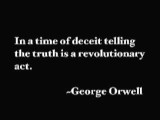
Freedom to Fascism