






















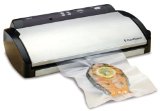

This is the model I have and use...
for more than just food.
An Invaluable tool!


Burger & Broccoli Pt. 1
Burger & Broccoli Pt. 2
Spaghetti Sauce
Found a good "Drying & Dehydrating Foods" link? Let Us Know!
Drying Food University of Illinois at Urbana-Champaign. Drying
is the oldest method of preserving food. The early American settlers dried
foods such as corn, apple slices, currants, grapes, and meat. Compared with
other methods, drying is quite simple. In fact, you may already have most of
the equipment on hand. Dried foods keep well because the moisture content is
so low that spoilage organisms cannot grow. Now archived (PDF) on SSRsi.
Building & Using A Smoke House You can build a smokehouse of cinder
block or use an old refrigerator, then construct a separate, underground (or
lower) fire pit. The finished smoke house is quite versatile and will enable you
to smoke hams and bacon as well as drying meats.
Solar Drying Food Preservation Preserving fruits, vegetables, grains, and meat has been practiced in
many parts of the world for thousands of years. Methods of preservation
include: canning, freezing, pickling, curing (smoking or salting), and drying. Food spoilage is caused
by the action of molds, yeasts, bacteria, and enzymes. The drying process
removes enough moisture from food to greatly decrease these destructive
effects. See also:
Solar Dryer Plans
Solar Drying - 3 machines Food preservation by drying can reduce
wastage of a harvest surplus, allow storage for food shortages, and in some
cases facilitate export to high-value markets. This paper presents the
characteristics of three solar driers. A 15 US$ tent drier, a 400 US$ box
drier, and a 5,000 US$ tunnel drier are discussed. References are given to
solar drier vendors and sources leading to numerous other solar drier
designs. For an overview of solar drying theory and equipment
classification, refer to “Solar Drying Technology for Food Preservation”
(Green & Schwarz, 2001).
Solar Food Dryers Larisa Welk and Lucien Holy: Starting with a
request from a reader for an inexpensive solar food dryer, this project has
grown into a valuable learning experience. Here are two types of solar food
dryers we would like to share with you. One is for humid climates, two
others for dryer climates.
Homemade Smokehouses:
The term "smokehouse" is normally applied to a cabinet, room or building which
is capable of cold smoking: exposing meat to a smoke saturated environment at a
temperature of less than 100 deg. F. for an extended period of time. Commercial
units are available, but most folks just make their own. As you read the
following descriptions, you will understand the general requirements.
SOLAR CONVECTION GRAIN DRYER This Technical Bulletin contains plans and
information for a natural convection solar grain dryer. The design is best suited for use in
tropical or other climates where relative humidity of more than 80 percent
and temperatures about 27 [degrees] C are not uncommon.
UNDERSTANDING SOLAR FOOD DRYERS By Roger G. Gregoire, P.E. Dehydration,
or drying, is a simple, low-cost way to preserve food that might otherwise
spoil. Drying removes water and thus prevents fermentation or the growth of molds. It also slows the chemical
changes that take place naturally in foods, as when fruit ripens. Surplus
grain, vegetables, and fruit preserved by drying can be stored for future
use.
Improved Food Drying and Storage Training Manual The main focus of
the program is the technical training of Peace Corps Volunteers and their
Counterparts, to be able to design, build, use and maintain improved food
dryers and stores.
Preserving Food by Drying: a Math-Science Teaching Manual (Peace
Corps, 1980, 218 p.) Preserving Food by Drying is a design for teaching
science principles and mathematics concepts through a sequence of activities
concentrating on weather, solar food dryers and nutrition. Part I
concentrates on the effect of the sun's energy on air and water: students
learn about evaporation, condensation, radiation, conduction and convection.
Applying these concepts to food drying, in Part II, students experiment to
build the most effective solar food dryer for their locality. Emphasis is
placed on using locally available materials and making the hardware needed.
In Part III, students use the food dryer they have built in experiments
demonstrating the effect of drying foods and the importance of using proper
drying methods. They then create balanced diets from the foods they have
dried and compile information about food drying for the people of their
community. The three parts each begin with an introduction and a diagram
outlining the major concepts covered. Concepts are presented through a
constellation of activities designed to keep students actively involved and
focused. Background information is provided before each related group of
activities.
Drying Foods, HYG-5347-97 Drying is the oldest method of
preserving food. Through- out history, the sun, the wind, and a smokey fire
were used to remove water from fruits, meats, grains, and herbs. By
definition, food dehydration is the process of removing water from food by
circulating hot air through it, which prohibits the growth of enzymes and
bacteria.
GH1562 Quality for Keeps -- Drying Foods Of all food preservation
methods, that of drying foods has received the most widespread and
enthusiastic publicity in recent years. Actually, drying is one of the
oldest methods of food preservation. Techniques have been passed from one
generation to another based on what worked and what didn't. Methods used for
drying food have become sophisticated over time. Initially, salting and
drying in the sun, an open room or on stove tops were the accepted methods.
It wasn't until 1795 that the first dehydrator was introduced, in France,
for the purpose of drying fruits and vegetables. Today, the variety of dried
foods in the marketplace has created a multimillion dollar industry. For
many people, drying food at home is a convenient way to preserve foods.
Drying Foods Guide E-322 Drying or dehydration, the oldest
method of food preservation, is particularly successful in the hot, dry
climates found in much of New Mexico. Quite simply, drying reduces moisture
necessary for bacterial growth that eventually causes deterioration.
Successful dehydration depends upon a slow steady heat supply to assure that
food is dried from the inside to the outside. Drying is also an inexact art.
Size of pieces, relative moisture, and the method selected all affect the
time required to dehydrate a food adequately.
Food Drying by Marcella Shaffer Issue 58 The oldest known method
of food preservation is drying food using the heat from the sun.
Unfortunately it has become the least used as freezers and pressure canners
have taken its place. While these methods of food preservation are certainly
effective, they have drawbacks when compared to solar food drying.
NFSD: So Easy to Preserve: Drying Food drying is one of the
oldest methods of preserving food for later use. It can either be an
alternative to canning and freezing or compliment these methods. Drying food
is simple, safe and easy to learn. With modern food dehydrators fruit
leathers, banana chips, pumpkin seeds and beef jerky can all be dried
year-round at home. Dried foods are ideal for backpacking and camping. They
are lightweight, take up little space and do not require refrigeration.
Drying Food Drying is a method of food preservation that
is simple, safe and easy to learn. It removes enough moisture from the food
so bacteria, yeasts and molds can't grow. Drying also slows down the action
of enzymes because it removes moisture, the food shrinks, and it becomes
lighter in weight. When food is ready for use, add water.
FCS3-501: Drying Food at Home PDF/Adobe Acrobat People
have been preserving food through drying for thousands of years. Because
dried food yields maximum quantity for the least volume, it has always been
popular among hikers and campers. Dried food, however, is not just for
people who enjoy the outdoors. Today, more and more people are eating dried
food as a healthier snack alternative to candy and chips. Because dried food
can be stored for long periods without spoilage, it makes good economic
sense, too.
| DRYING Foods - Michigan State University Extension | |||
| DRYING, GENERAL INFORMATION | PRE-DRYING TREATMENT, VEGETABLES | OVEN DRYING VEGETABLES | DRYING VEGETABLES IN A DEHYDRATOR |
| PASTEURIZING DRIED FOOD | PACKAGING DRIED VEGETABLES | STORING DRIED VEGETABLES | NUTRITIONAL CHANGES-DRIED VEGETABLES |
| USING DRIED VEGETABLES | PRE-DRYING TREATMENT, FRUIT | DRYING FRUIT | DRYING FRUIT IN THE OVEN |
| DRYING FRUIT IN A DEHYDRATOR | CONDITIONING DRIED FRUITS | PACKAGING DRIED FRUITS | TIMING DRYING FOODS |
| WHEN IS FOOD DRY? | SUN DRYING | ENERGY COST OF DRYING | NUTRITIONAL VALUE OF DRIED FOODS |
| FRUIT LEATHERS | USING GALVANIZED CONTAINERS | ||
Solar Food Drying The art of drying food using solar energy is a
little more complicated than you might think. We have tried to gather some
practical information and to provide links to other resources. Although
dried food is popular with campers, backpackers etc. this page is driven by
the need for solar dryers in areas where fruit is plentiful in summer
months, but because there is no simple and economic method to preserve it,
much of it is left to rot, while in the winter there is hunger.
Stefan's Florilegium - drying-foods-msg This file is a collection
of various messages having a common theme that I have collected from my
reading of the various computer networks. Some messages date back to 1989,
some may be as recent as yesterday.
Smoking Fish The fisherman's catch, if properly preserved,
can be a welcome addition to family meals over a period of several weeks or
months. Smoking is an excellent way to preserve fish that you don't plan to
eat right away. Fish is smoked as it dries over a smoldering fire. Wood
smoke adds flavor and color; the brining process helps to preserve the fish.
HOMEMADE MEAT, POULTRY, AND GAME
SAUSAGES: Sausage continues to grow in popularity. Sausage can be made
by grinding or emulsifying meat, poultry, or game, mixing in salt and other
seasonings, and then stuffing into a container or casing. Many meat
processors and local custom locker plants make excellent sausages. However,
you can make homemade sausages. They are particularly popular among hunters
who find that properly handled game, when made into sausage, is palatable
and highly nutritious. Making sausages
spiced to meet your own preferences is a further incentive to prepare them
at home.
Drying Foods Indoors Most foods can be dried indoors using modern
food dehydrators, counter-top convection ovens or conventional ovens.
Microwave ovens are recommended only for drying herbs, because there is no
way to create enough air flow in them. See also:
Drying Foods Outdoors
A Review of Solar Food Drying (The Solar Cooking Archive) Food
drying is a very simple, ancient skill. It requires a safe place to spread
the food where dry air in large quantities can pass over and beside thin
pieces. Sun is often used to provide the hot dry air. Dry, clean air
including dry cold air from any source will dehydrate food.
Drying chile peppers Chile peppers should be harvested for maximum
colour when the pods have partially dried on the plant, as red succulent
pods have not fully developed their colour. Pod moisture content from red
chile peppers is between 65% and 80%, depending on whether they are
partially dried on the plant or harvested while still succulent.
Drying Foods Food drying is one of the oldest methods of
preserving food for later use. It can either be an alternative to canning
and freezing or compliment these methods. Drying food is simple, safe and
easy to learn. With modern food dehydrators fruit leathers, banana chips,
pumpkin seeds and beef jerky can all be dried year-round at home. Dried
foods are ideal for backpacking and camping. They are lightweight, take up
little space and do not require refrigeration.
Back to Basics: Drying Vegetables For thousands of years people
have dried vegetables to preserve them for leaner times. Preserving foods by
drying is still useful, convenient, inexpensive, and needs less storage
space.
GH1563 Quality for Keeps -- How to Dry Foods at Home Drying does
not improve the quality of fruits or vegetables. Therefore it is important
to choose produce of high quality and at the desired stage of ripeness.
Before drying, produce should be sorted and that of inferior quality used in
some other manner besides preserving. Follow directions for preparing and
treating carefully, so that quality is maintained. For additional
information on drying food, refer to MU publication
GH1562, Using Dried Foods.
Food Safety of Jerky When raw meat or poultry is dehydrated at home
– either in a warm oven or a food dehydrator – to make jerky which will be
stored on the shelf, pathogenic bacteria are likely to survive the dry heat
of a warm oven and especially the 130 to 140 °F of a food dehydrator.
Included here is the scientific background behind drying food to make it
safe and the safest procedure to follow when making homemade jerky. See
also:
Jerky Food Safety
Howstuffworks "How Food Preservation Works" Because food is so
important to survival, food preservation is one of the oldest technologies
used by human beings. In this edition of HowStuffWorks, we'll look at
all of the different preservation techniques commonly used today.
Drying and Freezing to Preserve Food Covers methods, equipment,
preparation, drying times and storage.
Food Dehydrator Log - Contains a number Dehydrator recipes,
including Banana Chips, Fruit Rolls, Powered Eggs, Spaghetti Sauce and
Hamburger.
For large quantity food dehydration try this homemade gem from the past
The thing I like the most about Backwoods
Home is that, unlike a lot of other magazines, the articles are written by
folks who are actually doing the things they write about. It’s good to fool
around with new ideas, but we can use other folks’ experience as proven
starting points, and then adapt our own ideas and improvements into their
concepts. As an example of building on someone else’s experience, let me
tell you how I ended up building the perfect large-quantity food dehydrator.
solar dryer For around $50, perhaps even for no cost if
you are an inveterate hoarder and have a well stocked shed, you can make a
drying cabinet and enjoy the fruits (and vegies) of your labour all year.
Drying was probably the first ever preserving method used by humans, even
before cooking. Note the many foods that naturally dry and preserve on the
plant: grapes and grains for example.
GQTF-34:Drying of White Food Corn for Quality The need for high
quality corn is continuing to increase in the Midwestern United States. This
is especially true for high value specialty corn hybrids such as food-grade
white corn. Corn of high quality is essential for end users producing
products such as corn chips, tortillas, masa flour, and breakfast cereal.
High quality corn should be low in stress cracks and have a low, uniform
moisture content. Stress cracks are one of the most troublesome types of
corn damage caused by improper drying and cooling. Stress cracks are fine
cracks in the endosperm of the kernel, located just below the surface.
Kernels with a large number of stress cracks are more susceptible to
breakage, yield smaller grits during dry milling, absorb water too rapidly
during wet milling, and are more susceptible to insect and mold damage
during storage.
Drying Fruits Drying is a creative way to preserve foods and use
home-grown fruit, extra produce (e.g., ripe bananas) and roadside market
specials. Like all methods of preservation, drying causes some nutrient
loss. See fact sheet 9.308, Drying Vegetables, for specific
information on nutrient loss.
solar dehydrator There are several good reasons to make your own
dehydrated foods at home, and in particular if you are interested in bicycle
camping...
Howstuffworks "How Freeze-Drying Works" The basic idea of
freeze-drying is to completely remove water from some material, such as
food, while leaving the basic structure and composition of the material
intact.
Which Method of Storing is the Best? Many people want to know which
method is the best for storing their food, and depending on whom you ask,
you will probably get a different answer. Each method has different
advantages and disadvantages, depending on what your priorities are when it
comes to food storage. We have outlined the basic methods, and how they
affect your food storage. So you be the judge of the best method for you and
your family, and start getting prepared!
Jerky Recipes wwwboard
Making Beef Jerky and Turkey Jerky Jerky is simply meat with all the
moisture removed. It's one of the oldest known forms of preserving food. As
long as it's kept dry, jerky has a shelf life longer than a loaf of white
bread with preservatives. No self-respecting cowboy or Texas Ranger (not the
baseball kind) would be caught hungry as long as he had a few sticks of
jerky in his saddlebags.
Jerky Making: Then and Now Jerky is a nutrient-dense, convenient
and shelf-stable meat product that has grown in popularity world wide.
Derived from the Spanish word "charqui," which describes dried meat strips,
jerky may be produced using a combination of curing, smoking and drying
procedures. Traditionally jerky was made by the use of sun, wind, and smoke
from fires as a way to preserve and extend the shelf-life of meat. American
Indians mixed berries or suet with the pounded dried meat to make pemmican.
Today it is produced from either thin strips of meat (beef, pork, lamb,
venison, poultry) or ground and formed meat. Many varieties of commercial
seasonings are available for home use as a one-step procedure.
MAKING JERKY Jerky can be made from venison, elk or
Buffalo, but is generally made from beef. A good lean round steak or flank
steak will work great. Cut the meat in long thin strips against the grain.
If there's any fat or gristle, remove it and throw it away.
A Y2K Survival Recipes for Jerky and Pemmican This is an old, old recipe,
probably from about the time stone knives were getting good. This is a fair
bit of work, but since it is traditionally done when there is a lot of meat
about, it is pleasant work, and you can eat what you are working with.
Making Jerky in your Smoker One of the first things people want
to do with a new smoker is make jerky. Jerky can be easy to make in a
smoker, oven, food dehydrator or in the sun. Making jerky in a smoker adds a
great smoky flavor that you won't get any other way. However it is easy to
over smoke jerky because it is cut so thin before being smoked.
How to Make Jerky - Hunting Articles Muscles from the round or
leg are most often used. It is recommended that muscles be removed from the
carcass and made into jerky the day after the kill to prevent unnecessary
bacterial growth. However, aged meat can be used. Meat which has been frozen
and thawed can also be used satisfactorily.
Making Jerky PDF/Adobe Acrobat File: Jerky can be made
from almost any lean meat, including beef, pork or game. Making jerky is
easy, but there are some important steps to follow to help ensure a safe
product.
How to Make Beef Jerky, Recipes and Instructions Drying meats has
been used for centuries as a means of preserving it. Campers and backpackers
like jerky because it packs small, requires no refrigeration and can be used
in cooking as well as for snacks. Homemade jerky also makes a wonderful
addition to any gift basket.
Making Jerky Steps in Making Jerky from Beef, Game, or
Poultry
NFSD: Wild Game Handbook Freezing meat for a month before jerky
is made insures that it will be free from live parasites which are sometimes
found in game meat. In order to have freshly made jerky during the year,
many people freeze meat which is to be made into jerky. The meat is then
thawed in small quantities and made into jerky as it is needed.
Making Delicious Jerky at Home If you have hunters in the family
who bring home deer, a lightweight way to preserve meat is drying it into
jerky. Or, if you want homemade jerky year around, purchase lean beef roasts
or loins, slice thinly and you’re a day away from delicious jerky! How? Here
are some steps to follow to insure a delicious batch of jerky.
Millennium Ark: Jerky Jerky can be made from almost any lean
meat, including beef, pork or venison. If made from pork the meat must be
treated to kill the trichinella parasite before it is sliced and marinated.
This parasite could cause trichinosis. To treat the pork, freeze a portion
that is 6 inches or less thick at 50F. or lower for 20 days.
Poultry is not recommended for jerky, because of its texture when raw unless
it is ground or mince.
Solar food drying The oldest known method of food
preservation is drying food using the heat from the sun. Unfortunately it
has become the least used as freezers and pressure canners have taken its
place. While these methods of food preservation are certainly effective,
they have drawbacks when compared to solar food drying.
Homemade solar food dryer from Home
Power Magazine; also see the
GIF image that goes with this all text article. The
format is a little hard to read, but what do you want for free?
Back to Top
Please Read The Website Disclaimer!
Copyright 1986-2012, The Survival & Self-Reliance Studies Institute (SSRsi), All
Rights Reserved
Site conceptualized, designed, created & maintained by MEG Raven
Snail Mail: SSRsi, PO Box 2572 Dillon, CO. 80435-2572
