





















Making a Survival Spear
Survival Atlatl
Making an Atlatl 1
Making an Atlatl 2
Making an Atlatl Dart 1
Making an Atlatl Dart 2
Making an Atlatl Dart 3
Fletching Atlatl Darts
Atlatl Accuracy
Atlatl Dart Tuning 1
Atlatl Dart Tuning 2
Atlatl Dart Tuning 3
Atlatl Dart Tuning 4
Throwing Chopsticks
A screwdriver
Found a good "Thrown Weapons & Clubs" link? Let Us Know!
Jump to Section on:
| Slings/Slingshots | Bolo/Bola | Lasso/Lariat | Whips |
| Stars/Staples/Rings | Boomerangs | Spears | Staff/Cudgel |
| Knives/Spikes | Axe/Hatchet | Mace/Hammer | Siege Engine |
Blowguns While technically not a "thrown" weapon, these versatile
weapons have been effectively used on small game for centuries.
A viewer, "Cringe," comments: "just a suggestion
to the found object weapons thingee... Rebar,
thrown if you find a short piece - not the 6 foot pieces. A piece about a
foot and a half is pretty good. If it doesn't stab into the target it knocks the
(heck) out of it. Like a throwing stick, I guess. Also a small piece of rebar
that's just a little too big for the hand makes a good improvised Kubotan that
you just "found" if you can't carry weapons. I have one all the time. [15 Jul
2008]
Slings/Slingshots
The Chumash Sling by Paul
Campbell, copyright 1996 {Reprinted from the SPT Bulletin of Primitive
Technology, Fall, 1996} It has been questioned whether Californians possessed
the sling before European contact. Stephen Powers, however, reported it among
the remote Mountain Winton during his travels in the early 1870s and wrote that
miners before that knew its sting from these Indians. It was reputed more deadly
than an arrow and its missile said to have gone farther. The Western Mono
mountaineers employed the sling for war. Among the Yokuts, boys hurled the sling
as well. File recovered from now defunct AboTech website and converted to Onsite PDF.
Clay Thrower Made from Bamboo by Ken Peek and Dino Labiste: Last
year's excellent PBS (Public Broadcasting Service) series on Africa offered
up some wonderful insights into that amazing land and its cultural history.
One of the shows had a fascinating segment dealing with a family of poor
rice farmers trying to deal with marauding hippopotamuses. It seems the
hippos knew just when the crops were at their tastiest stage of development
before they trampled through the fields. To counter this onslaught, the
family had developed a simple, yet ingenious, low-tech solution...
LLOYDIAN WEAPONS: The Sling The sling seems to be something of an
under-rated weapon. Many wargamers see the bow as the ancient missile
weapon, used by competent soldiers, whereas ignorant barbarian peasants use
slings. In truth, the sling is an effective weapon, and has many distinct
advantages over the bow. See also:
ADVICE FOR THE WOULD-BE SLINGER
YouTube - How to Use a Sling
In this video, Jesse Hensel shows you how to use your sling to throw small
projectiles. see also:
Sling Launched Clayball Hits Deer Skull 1
and
Sling Launched Clayball Hits Deer Skull 2 and
How to Build a Sling and
SlingPro by Tint and his brother
Practical Slinging Very nice article with some great photos. Takes a
few seconds to load up - the whole page seems to be a .jpg or something.
Slingshot the Magazine
(& Website)
A Theory of Power, Jeff Vail's Critique of
Hierarchy & Empire
STAFF-SLING: GUIDELINES FOR CONSTRUCTION & USE
This article is intended as an introduction to a missile weapon which
was used extensively from Antiquity until the High Middle Ages, notably by
the Carthaginian, Vandal, Roman, Byzantine and other armies of the
continent. This weapon, the staff sling, was called the fustibalus (in
Latin).
Troubled Times: Staff Sling The Kurds teach their kids to use a
sling for small game. They use a thing "staff sling" to give the kids the
right timing and arm motion.
SLING SHOT HUNTING Properly constructed sling shots are truly
awesome - and deadly weapons!
Alas, many of the sling shots on the market today are regarded as junk, and
personally, I tried a couple of the supposed 'super' models, and found them
sadly lacking in performance and durability.
Back To Top
Bolo/Bola
Single Ball Bola (Bola Perdida): Believed to have
been used by primitive man more than 50,000 years ago. When a hunter discovered
a rock could be cast farther with more accuracy and more velocity than it could
by hand, if it had a cord or thong tied to it. Probably the predecessor to the
mace. Made famous in later years by the Ona Indians, of Tierra Del Fuego, who
used them to crush the skulls of Puma. But the Bola Perdida was and is used
world wide.
2 Ball Bola (Avestruccero): This bola comes in
various weights and measurements, depending on the size of the game. Probably
used 50,000+ years ago in pre-history, as a weapon of entanglement. After
dropping his prey, the hunter would rush forward with a fire hardened spear to
finish the prey off. It migrated with tribes. World wide the most factual
history is with the Tehuehches, of Argentina, who used it to hunt Rhea. It was
made famous by the Gaucho's rounding up horses. It is difficult to use, but a
favorite of primitive weapons.
3 Ball Bola (Boleadora): This bola was probably
used some 50,000 years ago and also varies in weight and size depending on the
game. This self centering bola is the easiest to master. Like all bolas, with
the exception of the Bola Perdida, it is a weapon of entanglement.
The third ball, or Maneja, is slightly lighter than the other two. Some Maneja
are egg shaped and the one held in the hand. The slip joint always centers it
which creates the natural spread from the thrower to the target. It was made
famous by Gaucho's when hunting the Guanaco.

4,6,8 & 10+ Ball Bolas: These bolas were used
throughout the world in pre-history. They were lighter in weight than other
bolas and were mainly used for water fowl or small game. Many ducks and geese
were entangled in these bolas. Until the availability of shotguns, they were
always carried by the Eskimo's who called them Ka-Lum-Ik-Toun. They are still in
use today in many parts of the world.
~Courtesy of Bob Booth,
www.primitiveweapons.com/hist.html
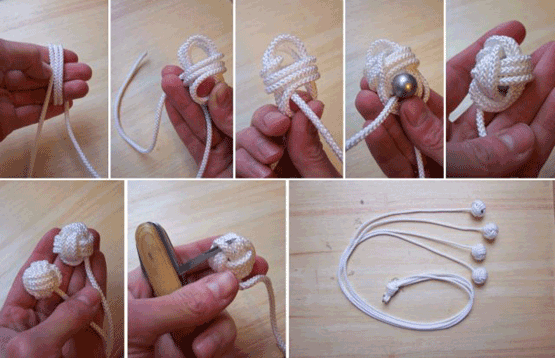
A simple modern example of a Bolas is shown above, using metal ball bearings and
nylon cord. The ball bearings are attached to the cord using a Monkey’s paw
knot. To tie this knot measure out approximately 30" of cord and wrap three
turns around your fingers (or as many turns required to enclose the weight).
Then pull these loops off your fingers and wrap three turns of cord around these
loops. Tip: ensure you start this by wrapping the cord around
the front of the loops not around the side/back. Finally wrap three loops
around these centre loops to finish the knot. Note:
when you have finished the first inner loop insert the weight, then finish off
the last two loops to enclose it. When complete, starting at the free end push
any slack cord back through the knot, if tied correctly each side will have
three parallel lengths of cord. Then finally using an awl or a sharpened stick
repeat this process to fully tighten the knot i.e. the bottom left frame shows
the difference in size between a fully tightened and loose knot. Four of these
knots are then tied together using a simple overhand knot, the cords are
approximately 30" in length.
How to Make Bolas: Have you ever
read "Mattimeo" and wanted to have bolas just like Slagar the Cruel and attack
your enemies? Well this guide shows you how to make it from household items!
The Bola or Boleadora: The
bola, or boleadora is a primitive hunting tool that was originally used by the
Chinese, Eskimos and South American Indians. Bolas are a throwing device made of
weights on the ends of interconnected cords, designed to capture animals by
entangling their appendages (legs, wings). They are most famously used by the
South American gauchos.
Hohokam Bola Petroglyphs in South
Mountains of Phoenix: The Gauchos of the Argentinean Pampas and the Inuits
have shown the bola to be a very effective weapon. Bolas can easily be made from
common materials.
SurvivalIQ Handbook: Survival Skills -
Field-expedient weapons ... The bola is
another field-expedient weapon that is easy to make (Figure 12-7). It is
especially effective for capturing running game or low-flying fowl in a
flock. To use the bola, hold it by the center knot and twirl it above your
head. Release the knot so that the bola flies toward your target. When you
release the bola, the weighted cords will separate. These cords will wrap
around and immobilize the fowl or animal that you hit.
Tuchuk Weapons
The technique for attacking with the bola calls for an extremely quick
victim. It is thrown low, so that it wraps around the legs of the victim.
The swiftness of the attack combined with the bola's ten-foot sweep makes it
almost impossible to evade. The leather straps strike the victim and
immediately tangle around the legs.
Bola It consists of three
long straps of leather, each about five feet long, each terminating in a
leather sack which contains, sewn inside, a heavy round metal weight.
Developed for hunting fleet-footed and flighted game it is also used as a
weapon of war.
weapons (near the bottom of page) The bola is much more difficult to
use but is simple to make. Tie all three ends of the pieces of string or
cord (I use parachute 550 cord) together at one end. At the other ends, tie
a stone on each piece of line. You now have three cords with a stone on each
end that meets and is secured at the other end (See the bola illustration).
Inuit Bola A Bola was
primarily a hunting weapon used by many aboriginal peoples throughout the
Americas in the past. While those in the south may have made their Bolas
from a range of local materials, the Inuit made theirs from sinew and bones.
The Bola was whirled overhead and thrown at an animal's legs to entangle the
legs and prevent the animal from running.
Inuit Hunting Bolas: The bolas is a hunting weapon used by many Aboriginal
peoples throughout North America. This Inuit example is made from carved antler,
cotton cord, hide and bird quills. The bird quills are tied together to form a
handle.
Office Bricolage: Strapping Tape Bola
This is just for chuckles.... or is it?
Hunting With Bolas (From SSRsi's
Primitive Wilderness Survival Guide)
Bola Design & Use: Great post by Matt Rapaport.
Proper bola throwing: Interesting article from Ben & Andre.
Back To Top
Lasso/Lariat
La Riata - The Lariat. ~ Making & Throwing the Lariat Excerpt from the: "The Outdoor Handy Book ... for Playground, Field & Forest" By D.C. Beard, 1914; Chapter XXXIII: Properly speaking, there is no such thing as a "lasso." You may lasso things with la riata, but you cannot carry a "lasso," because lasso is a verb, and no cow-boy carries a verb coiled at his saddle-bow though he may have strings of forcible adjectives under his tongue...
| Rope Spinning : Special thanks to The Inquiry Net for hosting & providing this information! |
| HOW TO SPIN A ROPE: Lariat throwing, Rope Spinning and Trick Cowboy Knots By BERNARD S. MASON |
| I.
HOW TO MAKE A LARIAT:
How to Throw a Lariat,
Wind-Up Throw,
Roping Moving Targets II. How to Spin It: The Body Spin, The Flat Spin, Merry-Go-Round, The Famous Skip III. TRICK COWBOY KNOTS IV. TYPES OF LARIATS AND THEIR CARE |
| See Also: Rope Making |
The Lasso: A rational guide to trick roping. By Carey Bunks. Online book tells all! Check it out! Now you can download it from this site as well.
| Ropers Knots Page on realknots.com | |
|
The Web Knot index A B C D E F G H I J K L M N O P Q R S T U V W X Y Z |
|
|
Stoppers Terminal Knots Overhand-knot, (Flemish) eight and more |
bends To bend two lines together. Reef-Knot, Sheet-Bend, Carrick-Bend, True-Lover's, and more |
|
Hitches To tie on an object. Timber Hitch, Constrictor, The Eight, and more.. |
Single Loops Bowline, Bowstring, and more... |
|
The Noose The running bowline, hangman, and more.. |
Frequently Asked Knots. The monkey fist, Dolly (trucker-hitch). |
|
Breast plates. Some Fancy work |
Links to other knot sites .At the base of realknots |
Back To Top
Whips
Choosing Your First Whip. The number one rule is no matter what
kind of whip you want, snake whip, bullwhip, stock whip, or cow whip it
should be a "quality whip". You get what you pay for. A cheap whip might be
inviting to someone wanting to learn how to throw whips inexpensively. There
are alternatives to spending $400 on a whip but in the long run you will
always have a good whip with a high resale value. See also:
How to care for your whip. and
Bullwhip Repair and
Bullwhip Safety
The
Bullwhip FAQ v5.6 See also:
Whip FAQs &
News and Articles
BULL WHIP TUTORIAL on making your own whip. See also the
SNAKE WHIP TUTORIAL
The Bullwhip FAQ on the juggler website, has lots of stuff like
target cutting, wrapping, The Hungarian Pig-Drovers Crack, Sidearm Crack,
Forward Crack, Overhead Crack and it's variations, The Quick Sixer, Safety,
etc. It is the work of 9 whip artists and includes
Quick/time VR video clips of Karen Quest demonstrating her elegant whip
handling technique.
Whip guide
General Whip Information. articles on all kinds of subjects
regarding whips.
On
accuracy ... The shortest distance between two points is a straight
line. It is also the most accurate. So how does this relate to whips?
whips-msg A series of discussion group messages from Stan's
Back To Top
Knives/Spikes
Weight & Center of Gravity of Throwing Knives First of all, not too
heavy. But my first throwing knife had only 90g, and that was far too light.
Then came one with 140g, currently I use a knife with 200g. This is about
fine, but if later you want to throw more than 1 ½ turns (from 5m and
further away), you should use heavier ones, 240g or more. You will need
quite some finger power and training to handle those.
The Blade
& Handle of a throwing knife A throwing knife should not have a
sharp blade! You might easily cut yourself when handling it, and bounces
from the target become really dangerous. Blade grips are only possible if
the blade is blunt. The throwing knife will not stick better with a sharp
blade.
Sheaths &
Knife Care It should ensure that the knife will not fall out (sewn
tight, snap-fastener or loop). A leg string comes handy as it prevents your
tool from banging against your thigh when walking.
Unusual
throwers Of course you can not only throw knives but virtually
everything that comes to hand: screw drivers, large Nails or old scissors
(these will yield even two throwers :-)
How to
throw knives John Bailey is a professional knife thrower I met in
Solingen, Germany. He was visiting the factory where two throwing knives
that he designed (the Tan-Kri and the Starlight), are manufactured. And on
this occasion, he taught me his throwing technique which I think is very
easy to learn, efficient and elegant.
An Introduction To Throwing Knives As A Hobby What makes throwing
knives so interesting is that it is challenging yet simple. You are working
with one of the most fundamental tools human kind has benefited from for
thousands of years. Really, when it comes down to it, a knife is not a
complex instrument. It is a piece of metal, or obsidian, or even wood, that
is designed to cut. Sure, there are knives that are more advanced than that,
but the fundamental concept is the same.
knife-throwing-msg A series
of discussion group messages from Stan's
Basic Throwing Knives,
tomahawks, and spears
Get Your Free 101 Knife
Throwing Tips Info-Pak Today: In addition to dozens of tips to help
you increase your skill and enjoyment of the growing sport of recreational
knife throwing, you'll also get hundreds of great knife throwing ideas,
articles and views from some of the biggest names in the sport. Your free,
101 Knife Throwing Tips Info-Pak will be delivered within 24 hours.
Knife Throwing Techniques from Extremely Sharp Knives
Short, all text.
Back To Top
Axe/Hatchet
Tomahawk Targets &
How to Throw a Tomahawk In the good old days when our brave pioneer
ancestors carried long rifles with barrels made of imported horseshoe nails,
the wooden stock trimmed with brass and ornamented with eagles, 'coons,
deer, and other objects cut from shells and set into the wood, they also
carried tomahawks. Trusty tomahawks in the leather belt which en- circled
the waist and belted in the wammus--and, like their neighbors, the redskins,
many of the picturesque old fellows were expert in the use of these little
camp axes as weapons of offence and defense.
How to Throw an Axe A number of times in my work with scouts, I
have demonstrated how to throw the axe at a target. Scouts have taken to the
game avidly, and soon there would be a spirited competition under way. The
knack is easily acquired, and the game has a certain thrill which appeals to
every boy.
A Basic Manual on Tomahawk Throwing by R. E. Valade & Illustrations
by E. J. Valade. Tomahawk Throwing. People familiar with tomahawks and their
use often refer to them as "hawks". Similarly, terms like pipe-tomahawk have
been shortened to pipe-hawk. Tomahawk targets frames are usually called
hawk-boards or hawk-blocks.
Throwing the Tomahawk Of all the skills of the early frontiersman,
few have the romance attached that throwing the tomahawk does. We've all
seen it done with aplomb in various movies and TV shows, and it is made to
seem a deadly, frequently used skill. That's probably mostly modern day
imagination, because few recorded accounts of its being done in combat have
come down to us. When you think of it, who would want to throw away a
perfectly good weapon? We will probably never know the truth about it, but
that shouldn't prevent our having a lot of fun with it. It certainly is a
favorite pastime at most rendezvous, and will continue to be. Copyright © B.
E. Spencer 2001 All rights reserved.
Back To Top
Stars/Staples/Rings
Staple throwing Staples, by the way, are those "U" shaped nails
that are used to attach wire fences to wooden posts. The best kind are the
big ones, 1 3/4" 9 gauge. I get mine at the local hardware store for 88
cents a pound. Other sizes can also be thrown but the big ones have more
heft to throw at the target.
Ball Bearings as weapons. The entire article is in fixed format JPG
image form, pictures and text in two separate image files. Each file will
take you to the other, or you can go to either of the pages directly from
the links.
Chackrum. The Chackrum (or Chackra) is a
metal ring that has been used as a throwing weapon by the Sikhs of India for
hundreds of years. The Sikhs became martial under Guru Govind Singh and used
the Chackra effectively against the Moghul dynasty. The Chackrum
has a history that is as old as Indian civilization itself. It's useage is
embedded in Indian myth and legend. Interesting read & photos.
RINGS & HOOPS: Their Relativity to Combat. The Singh Chakram
By: J.A. Keating. Wild read.
Back To Top
Boomerangs
Frequently Asked Questions about boomerangs:
throwing, tunings and shape problems. This site actually has a whole
bunch more than the FAQ, so feel free to browse around awhile. Don't forget
to come back here, though... See also:
Frequently Asked Questions Concerning Boomerangs - original first posted
to alt.boomerang on April 17, 1993, now hosted on this site.
Primitive Hunting Weaponry: Survival Weapons of Today. PART 2: The
Throwing Stick or Rabbit Stick By Benjamin Pressley
The rabbit stick is basically a throwing stick used for the taking of small
game. It also has been known to go by other names such as throwing club,
killer stick, baton and as I shall discuss later, the well known boomerang
of the Australian aborigine and other cultures. Another common name for this
type of weapon is the "kylie". This word originally meant a returning type
of boomerang and its meaning was changed by modern European man.
Unspinning the Boomerang by Hugh Hunt. "My boomerang won't come back"
goes the song about the disgraced Australian Aborigine. Well, that's not so
bad a thing because boomerangs used for hunting kangaroos aren't meant to
come back - they are heavy, hockey-stick-shaped throwing sticks that move in
a confusingly wobbly path, and they are designed to break the legs or wings
of any 'roo or bird they encounter.
A good overview of the development of the boomerang
The use of the throwing wood is verified by rock
paintings dating from the Neolithic Age (since approx. 5000 v.Chr.). Finds
from this time are not really suitable as unique proofs, because wooden
pieces of equipment are only hard to preserve through thousands of years.
The throwing wood was mainly a hunting weapon (long-range weapon, flying
weapon) to hunt hares, birds and other small animals. Its use as a battle
weapon played a minor role. Also available
here
How to Boomerang If you are new to the sport of boomerangs we hope
you find it to be a blast!! Similar to a good golf swing, boomerangs require
patience and practice to develop the required skill. Some boomerangs are
easier to throw than others. For quick positive results start with the
easier to throw models, such as the Yanaki, Seagull, Phoenix, and V.
| Boomerang Instructions by GEL BOOMERANGS | ||
| Articles | Instructions | Flight Problems and Solutions |
Types of boomerangs Boomerangs are made in an infinite variety of
shapes and sizes. They can range from the traditional v-shape to ones shaped
like the rest of the letters of the alphabet. At least one boomerang maker
has made a collection of boomerangs shaped like every letter from A-Z. Some
are in the shape of animals or people or just weird looking.
How boomerangs are made Boomerang relics have been found all over
the world, from the Americas, to Eastern Europe and Russia, to Australia.
Thru the centuries such diverse materials such as wood, bone, hardened
leather, and even mammoth tusk ivory have been used to make boomerangs.
Why do they come back? Any spinning object is subject to
gyroscopic precession. Which simply means that any attempt to move a
spinning object is translated at right angles to the original input... Or in
layman's terms - magic makes it come back. See also
J&N Boomerang's
How They Work...
Boomerang Software
Throwing and Catching Boomerangs. Most people have some
knowledge of boomerangs. Quite a few remember souvenir or plastic toy
boomerangs that they had as a kid. The main thing they remember is that it
rarely came back, if it came back at all. This guide will help you learn how
to throw a boomerang so it returns, the best way to catch it when it does,
and other fascinating things.
Hunting with throwing sticks A collection of sling messages
from the Primitive Skills Group archives.
Back To Top
Spears
The Atlatl and Dart ~
An Ancient Hunting Weapon by Thomas J. Elpel: Through the eons of prehistory,
primitive peoples from all over the world developed hundreds of unique weapons
for hunting game. Among all the technologies invented the atlatl and dart was
the first true weapons system, consisting of both a projectile and a launching
device. The atlatl, essentially a spear-thrower, was developed in Europe more
than 30,000 years ago, and in North America about 12,000 years ago. By
comparison, the bow and arrow first appeared here only 2,000 years ago. File
recovered from now defunct AboTech website and converted to Onsite PDF.
Simple Atlatl Spear Thrower Construction
by Bob Gillis. No text really, but pretty self-explanatory photos.
Making an Atlatl from a Branch
by Dino Labiste: The atlatl was used for thousands of years almost
worldwide. It had the advantage of lengthening the throwing arm of the
hunter, thus more leverage to increase the speed of the dart. Despite the
worldwide variations in the design of the atlatl, the basic components are
still the same. They all incorporate a handle connected to a shaft with a
spur. See also:
Atlatl Dart Tuning
A Short Essay On SPEARS. "Sometime ago I started putting
together notes on easily made weapons and started off with spears since most
survival books make this out to be quite simple. Just grab a length of wood
and sharpen one end and off you go. Not quite." Quite a good article. Fun
read.
The Shingle Dart
by Dick Baugh (1/10/05): My introduction to the shingle dart came from my
Dad when I was eight-years-old. He acquired an old cedar shingle, whittled
it into the shape of a weather vane and cut a notch exactly at the balance
point. Not much practical use, but loads of fun!
Hunting with spears & atlatls Huge collection of sling messages from
the Primitive Skills Group archives.
Atlatl Weights Atlatl weights, both known and suspected, are a
fascinating and frustrating subject. Based solely on the misinterpretation
and lack of understanding surrounding them, and their occurrence in the
archaeological record, debate and confusion as to their purpose has set them
apart from most other artifacts.
Atlatl and Dart Mechanics The mechanical foundation of Atlatl
technology is the flexible Dart. Under acceleration by the Atlatl, the Dart
flexes and compresses like a spring, storing energy to be used to push
itself away from the Atlatl and launching at velocities that easily exceed
100 mph.
Atlatl Archeology Over 12,000 years
ago, hunters tracking herds of the last ice age across the frozen tundra of
what is now the state of Alaska became the first immigrants to enter the
North American continent. These hunter-gatherers brought with them a weapon
that reigned supreme among them and their descendents for thousands of years
to come, the Atlatl.
EFFECTS OF STONE PROJECTILE POINTS AS A MASS
WITHIN THE ATLATL-AND-DART & MECHANICAL SYSTEM
AND ITS RELATIONSHIP TO THE BOW-AND-ARROW
The Dynamics of Spear Throwing
"Spear Thrower Dynamics", initially published in the American Journal of
Physics. This is a detailed model and analysis of the human effort
involved in throwing a spear with an atlatl or spear thrower. Download pdf
files to read the article.
part1 |
part2 |
part3 |
part4 |
part5 |
part6
Back To Top
Staff/Cudgel
The Manly Art of Quarter-Staff Origins of a Victorian Combat Sport
Tragically, many young English athletes gave up their lives in the trenches
of the First World War, and the generation that might otherwise have
perpetuated the new sport of quarterstaff fencing was all but lost. Many
other Victorian-era combat arts and sports were similarly afflicted, some
experiencing a brief revival in the 1920s (such as quarterstaffing as
practiced by the Boy Scouts) before finally succumbing during the Great
Depression and then World War Two.
Making a
Quarterstaff: The British tradition is to make your own staff. The
ancient ballad of Robin Hood (15th century or earlier) describes how Robin
cuts a staff in order to fight with Little John.
Gabrielle's Staff Techniques The staff is a melee weapon. Melee
weapons are an attempt to increase the damage an individual is able to cause
over the use of empty hands. They accomplish this through the application of
several principles. A melee weapon can increase momentum (rocks), reach
(sticks), or damage (blades). The staff increases reach and momentum over
the empty hand. Staves are among the earliest of weapons.
A Brief History of the Quarterstaff The Quarterstaff was for
centuries considered the weapon of the lower sections of society, although
the nobility had a healthy respect for the Quarterstaff, which they also
practiced. In reality Quarterstaffing, as a fighting art reigned supreme in
England for many centuries. The English art of Quarterstaffing has
throughout the many centuries, gained its own individuality and traditions.
Through the dedication of the men and women, who for generations have
brought this majestic weapon forward into the 21st century, with the blood
sweat and tears of hard practice, and hard knocks.
QUARTER-STAFF: A PRACTICAL MANUAL BY THOMAS A. McCARTHY. THE object
of the author in compiling this little work is to fill an evident gap, there
not being any special treatise in existence upon the once-popular art of
Quarter-staff. The Exercises have been carefully chosen from those that the
author has himself used, during sixteen years’ experience, some of which
Exercises are used by Amateurs and Instructors, both at drill and in public
performances.
The Quarterstaff – a chapter from
"Broadsword and Singlestick" (1898)
Singlestick – a chapter from
"Broadsword and Singlestick" by R.G. Allanson-Winn and C. Phillipps-Wolley
(1898)
Sword Forum International - Quarterstaff Questions
Back To Top
Mace & Hammer
King Philip's War Club The club is made from the ball root of a
maple tree. The ball root develops when the root system of a tree hangs over
a stream bank in such a way as to expose the roots and cause them to grow at
an angle.
Maces and Morning Stars You can buy them here, but this is not an
endorsement by SSRsi. The mace, a short club like weapon with a flanged
head, was a symbol of rank and status as well as an effective weapon against
plate and mail armour. Unlike the sword or axe, the mace was easy to use,
very tough and did not require sharpening. The morning star is similar to
the mace however it typically has longer and sharper spikes.
Cleith ailpi/n (cudgel) This page is entirely devoted to the art of
Irish stick fighting in it's many forms and incarnations. From the Lorga
Iarnai/(iron tipped cudgel) to the Cleith ailpi/n (cudgel), the art of the
Irish stick or Bata has been overlooked for too long. What I am doing here
is putting together an internet resource and gathering point for information
pertaining to Irish Stick Fighting as done by the Faction Fighters of the
early 19th century and earlier.
Back To Top
Siege Engine
Historical Counterweight Trebuchet Pictures This is a page of
illustrations of trebuchets from 14th to 16th century sources. These are not
modern reconstructions but drawings made when the machines were in use.
Brief notes and opinions accompany each picture.
How Do Trebuchet's Work? Something to get you started ... a
little simplified information to give you an idea of how a trebuchet works
and what the various parts are for. This page will be expanded soon to
provide the more advanced trebuchet fan with a little "real world"
refinement to the original "Getting Started" approximations.
Trebuchet Triggers A look at a bit of a mystery - how were
trebuchets triggered?. We look at some of the pictures from the Grey Co
Trebuchet collection of trebuchet images - hunting for clues as to how the
medieval siege engineers made machines weighing tens of tons loose their
missiles on command.
Traction Trebuchet Spotting Visit the "Traction Trebuchet
Spotters Page" - an introduction and guide to the various parts, workings
and types of historical traction trebuchets.
Historical Traction Trebuchet Pictures This is a page of
illustrations of traction trebuchets - the human-powered siege engines that
appeared before the weight-powered ones. The traction trebuchet is also
known as perrier, petraria and petrobole (all meaning "rock thrower"). As
above, these pictures are not modern reconstructions but drawings made when
the machines were in use. Brief notes and opinions accompany each picture.
Trebuchet Simulators Mathematical models for Virtual Hurling.
There are some very good computer simulations out there that allow the
would-be trebuchet builder to avoid many of the worst trial-and-error
pitfalls. Here are a few links to some of the world's best virtual
trebuchets.
The Virtual Trebuchet An applet-based trebuchet simulator with
suggested exercises to plug into it
Rick and Carl Build A Ballista
During the winter of 1997/1998, I was directed to a web page describing the
construction of a small ballista. I told my friend Rick about it, and he said
"hey, wanna build one?" I was a bit reluctant to commit the time and effort at
first; but he convinced me. So during spring break, we built this thing at my
apartment.
The Bungeelista ~ Or, How
to Build a Surgical-Tubing Ballista. A ballista that uses surgical tubing is a
bit easier to make than one that uses real torsion skeins. There are fewer
parts, and the only moving parts are the tubing and the catch in the release
mechanism. I know some people will argue about calling this thing a ''ballista''
because it's powered by the elasticity of latex tubing instead of torsion.
That's OK, I just want it to work. And it does work; the ones I've made
according to the ideas expressed here will throw an unstuffed GT bolt more than
80 yards when the wind is calm. And it does look sort of like a ballista from 20
yards. Hopefully the recipient of its projectiles won't last long enough to be
offended by its appearance.
Appendix D - ballista calculator With computer spreadsheets it is
relatively easy to work out the formulas for a ballista. I have developed a
"Ballista Calculator" using Excel that will calculate the correct diameter
of the skein in dactyls, inches or centimeters based on the weight of a
stone in minas, pounds or grams.
Bullock's Trebuchet The trebuchet is an ancient siege engine used
for throwing large rocks. It was invented in China in about the 4th century
BC, came to Europe in the 6th century AD, and did not become obsolete until
the 16th century, well after the introduction of gunpowder.
Grey Company Trebuchet
Here you'll find a lot of pictures and a few words about these amazing
pieces of "leverage artillery" - strange machines referred to variously as
trebuchets, traction trebuchets, perriers, petrarias, war wolves, coulliards,
bricoles or even "the witch from whose head the ropes hang like hair". Some
of the site is devoted to providing background information into how
trebuchets were used "in anger" in times past - while other parts of the
page celebrate the joy of using them today as a wonderful sporting toy.
Historic Traction Trebuchet Illustrations The Traction Trebuchet
image collection has been broken up into smaller, faster-loading pieces. Now
you can choose between looking up the particular trebuchet you want from an
index - or taking a stroll past the ranks of all the machines on show.
Onager Online A site from a team of guys seriously into pumpkin
chuckin'
Reconstructed Medieval Mechanical Artillery This page is dedicated
to the reconstruction of projectile-throwing siege engines.
Society of Ancient Military Historians Home Page The Society of
Ancient Military Historians is an organization dedicated to the promotion of
the study of warfare in the Ancient World. Members sponsor and contribute to
the publication of our newsletter, Res Militares. Our leadership works with
and within the American Philological Association to arrange contact between
our members and within the larger academic community.
The
Algorithmic Beauty of the Trebuchet <-- TREB GEEKS LOOK HERE! On the
physics and mechanics of a medieval trebuchet, a type of catapult, its
design, working and optimization through improved simulation and
mathematical analysis.
The Northern Exposure Trebuchet
Siege Engine Humor
Please Read The Website Disclaimer!
Copyright 1986-2012, The Survival & Self-Reliance Studies Institute (SSRsi), All
Rights Reserved
Site conceptualized, designed, created & maintained by MEG Raven
Snail Mail: SSRsi, PO Box 2572 Dillon, CO. 80435-2572