




















Found a good "Food Storage & Cache" link? Let Us Know!
Prudent Food Storage Frequently Asked Questions, version 3.50 also available in
pdf format or
rtf format. This Frequently Asked Question (FAQ) file is concerned
with those methods and techniques that are most useful to extending the
nutritive and palatability shelf lives of foods suitable for use in food
storage programs. In this compendium you will be taken through the ins and
outs of how to put away your storage foods and have a reasonable expectation
of getting something edible back out of the container when you finally use
them. Also covered will be food spoilage -- how to recognize it and how to
combat it. A resource list detailing where to find supplies and further
information is included at the end.
Proposed Cache for a minimum of three days (72 hours) usage to
allow time to get to primary resources with ability to be used for longer
period if required. Access to water and alternative food sources should not
be a problem in this geographical area. Note: All items stored in
individual plastic bags. Cache serviced once a year to replace
food/ammo/meds/batteries.
Caching Your Goods Of concern to many survivalists is long term
storage of supplies in a safe location protected from both accidental
exposure and those aggressively searching for your stash. For this reason,
creating a cache (rhymes with stash) of items you believe you will need in a
survival situation is a good plan for any serious survivalist.
Simplifying Food Storage Within 36 hours of any disaster, natural
or manmade, national or regional, the shelves of our food stores will be
bare. The availability of food is taken for granted, but it will not always
be so. Some of us have seen this temporary scarcity before, but within a
short time, food stores are re-supplied, and all is normal. If, however,
there are major upheavals or disruptions of the delivery system, it will
take considerably longer. During these chaotic periods prices will skyrocket
for the limited foods locally available . . . if there are any.
Wheat Storage Plans : STORING WHEAT CORRECTLY: Dark
hard winter, Spring, Dark Turkey Red and Montana White. Wheat is a dynamic
grain with a wide range of uses– hence it is regarded as one of the most
basic and essential food storage items by many experts, including James
Talmadge Stevens, author of the family preparedness book Making the Best of
the Basics.
Reasons Home-Canned Food Spoils Date: May 1989 (Revised April 1995)
Source: University of Minnesota Time, energy and money are lost when
food spoils. There are several reasons home-canned foods spoil. The most
common ones are: failure to heat process the filled jars, processing by an
incorrect method, processing for insufficient time, and failure of lids to
seal.
Preparing An Emergency Food Supply A slow loader, but worth the
wait. This is a document prepared by Elizabeth L. Andress, Ph.D., Associate
Professor and Extension Food Safety Specialist, Department of Food and
Nutrition at the University of Georgia. EXTENSIVE!
The Food Keeper
Supermarkets today have an amazing array of fresh, frozen
and prepared foods. Your store maintains rigid quality assurance and
sanitation standards to make sure you always receive fresh, wholesome and
safe food products. After selecting food items, though, it's up to you to
take care of them properly. The Food Keeper contains valuable food safety
and storage advice to help you maintain the freshness and quality of foods
that you purchase.
Make a fully functional cold storage pit-mound and enjoy your
garden’s production all winter
A properly designed and well built root cellar is a marvel
of appropriate technology. It soon returns its cost—and will ultimately
return it many times over. However, in the beginning, the problem of the
initial investment can be the main drawback to opting for a walk-in unit.
Many of us, therefore, have for a time resorted, with varying degrees of
success, to the traditional pit/mound storage.
7 Mistakes of food storage
If you are going to store food, make sure that the food you
store is adequate for the need you and your family anticipate. This may not
be as easy as to achieve as many people think, because the facts are that
most people make serious errors when storing food—errors that will come back
to haunt them when the food they’ve stored is the only thing that stands
between them and their empty, dissatisfied, bellies.
Here are some simple tips on how to store apples for a long, long
time
Almost any kind of apple will keep for three or four months,
or even longer, if stored properly. It’s cheap and easy to do. All you need
is newspaper, a box or basket, and apples. A root cellar is optional, but
not necessary.
Food Storage Calculator on About.com (watch out
for pop-ups)
Awesome
Info from Stan & Holly Deyo -
[email protected];
http://millennium-ark.net/
Storing Food.Nancy French, nutritionist and survival specialist, states "the
average city (in America) has a food supply of only eight days." This is
an amazing statement! As of January, 1998, Chuck Missler, Y2K expert,
put the figures much less optimistically at only three days' supply in
the grocery stores! In the case of panic purchasing, the three days'
supply would rapidly disappear. The average home in America has less
than a one week food supply. If your budget can withstand a little
stretching, food storage planning would be a good idea.
Basic Food Storage Calculator Really cool online program! You
input the number of members in your family/party and the number of
months you need food for - then click on "calculate." In seconds, the
chart displays how many pounds or gallons of the basics you would need
to store and estimates the cost.
The Deyo Food Storage Planner program works in Excel for either
Macintosh or Windows and is a straightforward, easy-to-use spreadsheet.
You will also need the latest version of Unzip to decompress the
program. All you need to do is fill in the number of family members and
how many weeks you want to store; the worksheet will calculate the
quantities needed.
Esther Dickey's 40 + 4 A food & storage plan apparently based
on the Morman guidelines with some extras.
Kearny's Survival Food Plan Another food plan covers one year
with bare essentials. These are suggested basics only. You can build,
add to or alter to suit personal taste. Many folks want guidelines for
"how much". That is the intention of this plan.
Mormon Table of 4 The most basic food plan is the Mormon
Basic Four from the Church of Jesus Christ of Latter Day Saints'. You
may want to use it as a starting point and build from there since it is
the backbone of numerous other survival programs.
Mormon 52 Week List The Mormons also have more specific lists
based on 52 week purchases or monthly purchases. Here you will find their official lists for each.
MREs and Heater Meals
| General Info | Sources For MRE's | Evaluation & Taste Tests | MRE Fast Facts | Recipes Using MRE's |
Food Shelf Life Recommendations Grocery product shelf life
is based upon the Manufacturer’s Date Packaged (DP) code. Manufacturers
encode the Date Packaged somewhere on the product in a form unique to their
internal procedures. My objective is to provide Date Packaged (DP) code keys
for well-known products to assist your food purchasing and rotation efforts.
Remember that these timeframes are the manufacturer’s recommendations
for MAXIMUM freshness and nutrient value. Several vendors indicated their
products are edible long beyond the published recommendation dates.
Cupboard Storage Chart at County Extension sites. Provides
recommended maximum storage times/methods for: STAPLES, MIXES AND PACKAGED
FOODS, CANNED AND DRIED FOODS, SPICES, HERBS, CONDIMENTS, AND EXTRACTS &
OTHERS.
The North Dakota State University
Extension Service page on Food Storage contains:
Preserving Sunflower and Pumpkin Seeds and Popcorn,
Care of Wild Game,
Drying Food,
On-the-Shelf Storage, and
Storage of Fresh Fish, Meat and Poultry
Stored Food Pests FAQ This FAQ covers several major groups of
Stored Product Pests; Insect pests, being beetles, weevils, and moths;
Rodents; and Fungi.
Download it!
Harvesting & Storing Potatoes The keeping quality of white
("Irish") potatoes (Solanum tuberosumL.) increases greatly if
tubers are harvested after vines are killed by the first fall frost.
Potatoes intended for long-term storage should not be harvested until the
vines have been dead for at least ten to fourteen days. This permits the
proper thickening of potato skins, which increases the length of time
potatoes can be stored. Potatoes harvested too early easily `skin' during
the harvesting and handling period and do not store well.
Shelf Stable Milk FAQ Gossner's Milk is excellent for traveling and
can be used anywhere at any time. It is ideal for camping. Include shelf
stable dairy products in your menus to add the nutrition in milk to your
away from home activities. Try your favorite flavor to breakfast cereal,
with a sack lunch, or as a delicious and healthy dinner beverage.
Borden Shelf
Stable Milk
Dealing w/Grain & Bean Weevils
Several types of weevils, including the rice, granary, maize and bean/pea
weevils, can be encountered in the home. They are all pests of whole grain
foods such as nuts, beans, cereals, fruits and seeds.
A.T. Hagan’s Food Storage FAQ, compiled from
misc.survivalism postings, is an excellent reference on all aspects of food
storage. Slickly presented by Capt. Dave for a truly enjoyable &
enlightening experience.
"Preparing the Survival Stash" (food) : From Capt.
Dave's Survival Guide. The many links make this well thought out article a
gold mine of information for anyone with the time and money to prepare a
survival stash. Everyone should have a 72hr grab bag, but from there on,
it's a matter of cash. If you can't afford to buy and hide a stash, you'd
better review the hunting and foraging stuff on this site!!
Misc.Survivalism's Food Storage FAQs are chucked full of information
invaluable to anyone interested in food storage, or using these foods. We
give a generous thanks to Alan T. Hagan, the curator of the
misc.survivalism food FAQs for permission to place them here. If you've
never visited
misc.survivalism, I encourage you to do so. You will be welcomed by lots
of nice, rough cut, patriotic folks who are in the midst of a constantly
raging battle of ideas that should be most useful to you. You can read the
Food FAQs online here or download them in a
136K zip file.
Rec.Food.Preserving FAQ (v.4.07) Part1-6 (Aug 25 1999, 72Kb)
Part2-6 (Aug 5 1999, 154Kb)
Part3-6 (Aug 5 1999, 187Kb)
Part4-6 (Aug 5 1999, 55Kb)
Part5-6
(Aug 5 1999, 46Kb)
Part6-6
(Aug 5 1999, 76Kb)
Food Storage Planner (FSP) is the easiest way to
estimate, budget, and plan your food storage. Events in recent years (i.e.,
hurricanes, earthquakes, floods, and the worldwide grain shortage) have
borne out the wisdom in obtaining a year's supply of food and, where
possible, fuel. But just how much is enough? And what should you store? FSP
can help. I don’t know if it’s essential, but for a mere $15 charitable
donation (on the HONOR system, no less) it seems like a good deal SSRsi
note: I guess the honor system wasn't working so well. Now you can still
download the trial version, but I don't think it is still fully functional -
and the price has gone up to $39.95 ($29.95 if you pay within 72 hours of
downloading).
Please Read The Website Disclaimer!
Copyright 1986-2012, The Survival & Self-Reliance Studies Institute (SSRsi), All
Rights Reserved
Site conceptualized, designed, created & maintained by MEG Raven
Snail Mail: SSRsi, PO Box 2572 Dillon, CO. 80435-2572

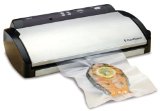

This is the model I have and use...
for more than just food.
An Invaluable tool!