





















								WAR DEPARTMENT,
								WASHINGTON, July 18, 1917.
The following notes on Deep Gallery Shelters are published for the information of all concerned.
[661.1, A. G. O.]
BY ORDER OF THE SECRETARY OF WAR:
				TASKER H. BLISS,
				Major General, Acting Chief of Staff.
OFFICIAL:
	H. P. MCCAIN,
	The Adjutant General.
								WAR DEPARTMENT,
								ADJUTANT GENERAL'S OFFICE,
								WASHINGTON, June 19, 1917.
To all officers of the Army:
You are advised that this and all subsequent documents of a similar character, which may be furnished to you from
this office, are to be regarded as strictly confidential. They are to be kept at all times in your personal possession,
and are not to be copied, nor are any parts of their contents to be communicated either directly or indirectly to the
press, nor to any persons not in the military or naval service of United States. In Europe these documents are not to
be carried into the front line trenches, nor farther to the front than the usual post of the officers to whom issued.
Strict compliance with this injunction is enjoined upon every officer into whose hands any of these confidential
documents may come.
BY ORDER OF THE SECRETARY OF WAR:
	H. P. McCAIN,
	The Adjutant General.
Contents
	Object
	Description and characteristics
	General description
	Interior arrangement and details
	Principles to observe
		Depth
		Longitudinal strength of galleries
		Precautions concerning entrances and descents
		Ground sanitary measures
	Defense of entrance
		Exterior defense
			Blockhouse traverses
			Prepared traverses
		Interior defense
			Protection against grenades
			Protection against gas
	Details of the work
	Diagrams
DEEP GALLERY SHELTERS.
CONFIDENTIAL FOR OFFICIAL USE ONLY.
Object.

The question of shelters has become a capital one in preparing sectors, because of the increasing intensity of
bombardments. As this bombardment is usually effected by medium and large caliber guns, it is absolutely
necessary that shelters destined to protect troops be impervious to systematic and regulated fire of 150 c.m. and to
individual rounds of a 210 mortar. Experience has proved that shelters covered with logs and earth were unable to
resist heavy shells with time fuses. Only shelters in mine galleries, called underground shelters, or deep dugouts,
can provide sufficient protection. Therefore they alone should be used.
DESCRIPTION AND CHARACTERISTICS.
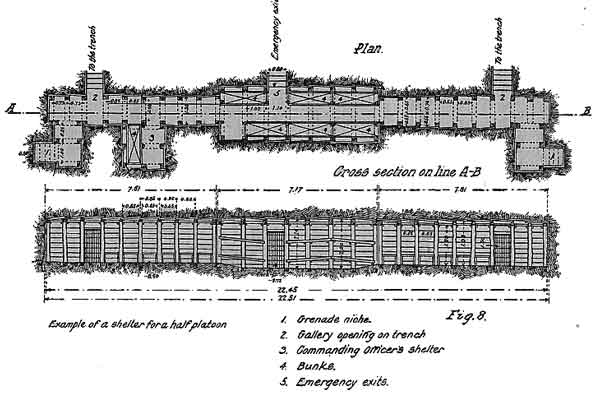
Shelters in mine galleries mean shelters dug in virgin soil, with roof and walls forming a solid inclosure, firmly wedged
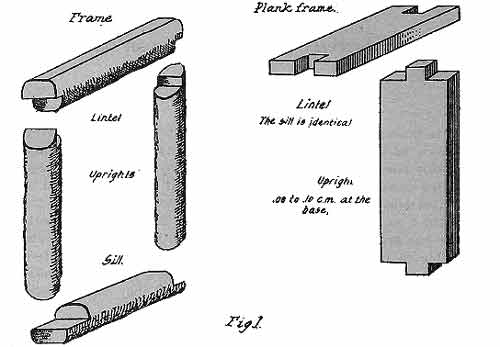
against the earth by a strong frame. These frames are usually made of thick logs, squared (0-20 c. m. at least). The
entrances are also solidly framed by thick planks.
CHARACTERISTICS.
The means at hand in the field are sufficient to provide shelter rapidly against projectiles of large caliber. They can
be easily constructed without arousing the enemy's suspicions, if pains are taken to unload the earth sufficiently far
away. They can be constructed all alike, practically, the frames being of the same workmanship, no matter how
varying in size, and put together in the same way. The method of building and the supervision of the construction is
easy. Although they seem to take long to build, they do not require longer than the ordinary log shelters, which can
only be worked on by day. Furthermore, as soon as they have reached a few meters in depth they can be used
under favorable conditions.
GENERAL DESCRIPTION.

There are double and single shelters. The single ones are almost the only ones used, the double ones being
reserved for extraordinary cases far behind the lines.
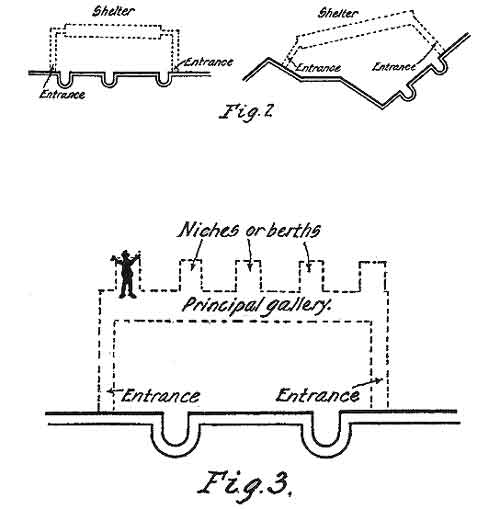
Single shelter. Formed by an underground horizontal gallery communicating with the surface by means of two
inclined entrances far enough apart to avoid both being affected by the same shell. In order to diminish their length,
the entrances should be as steep as possible 7/10 with ordinary frame, 1/1 with lined frame.
In order to permit leaving the shelter, even after the trench has fallen into the hands of the enemy, a third opening
should be built whenever possible, coming out in rear of the parapet, in a shell hole, communication trench, or
trench other than that containing the first two entrances. This last exit should be carefully hidden or even filled with a
mask of sandbags, which can easily be overthrown from within. The shelters can also be connected with observation
posts and machine-gun emplacements by means of underground galleries. Each shelter should be able to receive
an entire unit a half platoon, as a rule. If they are smaller the number accommodated would not be proportional to
the time and energy expended.
INTERIOR ARRANGEMENT AND DETAILS.
	I. Each shelter must contain berths (double berths) for a fraction of the unit occupying it. These berths are in the
gallery forming the main shelter or in niches dug perpendicularly into the ground. This last method is preferable, as
it allows for the construction of niches without impeding the occupation of the principal gallery, in case of need.
	II. Supply the shelters of the niche with hand grenades (the single ones should each have the supply for one man),
infantry munitions, gas protections, food, and signal rockets.
	III. Reserve a special corner for the platoon or half-platoon leader.
	IV. Construct chimneys for ventilation or to clear away the smoke, with a draft to be shut at the bottom.
	V. Watch the approaches to the shelter by a well-placed lookout post and a periscope position.
	VI. Prepare the defense of the entrances.
	VII. Protect the interior of the shelter against grenades.
	VIII. Protect the interior of the shelter from action of asphyxiating gas.
PRINCIPLES TO OBSERVE.
DEPTH.
Above the dugout roof there must be a minimum of 6 meters of virgin soil. If there are shell holes on the surface, go
down to 8 meters. If water level prevents reaching 8 meters, reinforcements are placed on the ground above the
shelter made by (1) bed of logs, .20 meter in diameter, side by side, separated by earth. (2) Cement blocks.
(3) Bags of cement placed in water for 10 minutes then placed side by side. (4) Bags of cement mixed with pebbles
and treated as above. The best reinforcing is not as good as virgin soil.
LONGITUDINAL STRENGTH OF GALLERIES.
The length of the gallery should be carefully looked after.
	(1) Nail the battens that join the uprights.
	(2) Place four horizontal props at the joints of the frames in each interval. The props must be strongly
	wedged and must prevent any play.
	(3) Make the length of the intervals .6 meter from axis to axis of the frame.
PRECAUTIONS CONCERNING ENTRANCES AND DESCENTS.
	(1) The last frame in the descent must be strongly supported against the woodwork of the shelter.
	(2) Place a number of tools and sandbags in each shelter, so that an entrance can be quickly cleared
	in case of need.
	(3) Place a cord or rope the length of the descent to facilitate the exit in case of obstruction.
	(4) Nail a shaft to one of the supports or fix a tube so that food and air may be obtained in case the
	entrance is destroyed. There are certain precautions to be taken when ordinary frames are used in
	descents to prevent the logs from rolling and the frame from overturning. These precautions are as
	follows :
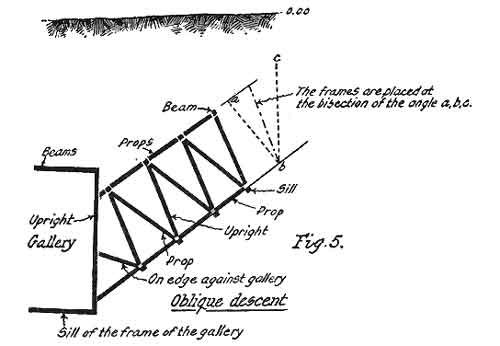
		(1) Join the beams to the uprights by two oblique battens in each corner.
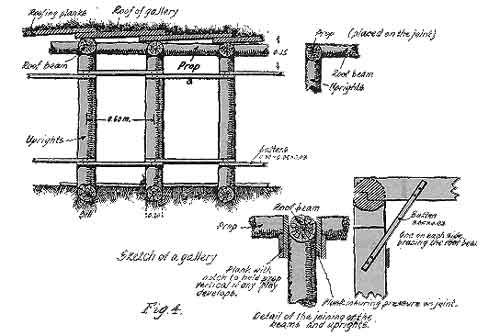
		(2) Connect adjoining beams by two battens.
		(3) Place diagonal braces in each interval of props to form an irregular system of triangles.
The figure shows the plan of the arrangement of the logs in an oblique descent and the junction with the gallery.
There can be no sliding or overturning of the frames with triangular propping. There is no harm in adding to the
dimensions of the wood and strength of the shelter.
GROUND SANITARY MEASURES.
	(1) Whenever possible, drain off the surface water by ditches and well-studied drainage.
	(2) Prevent the presence of dripping water by strong measures (sand bags, barriers, drains, high
	ground), etc.
	(3) There should be a small drain at the bottom of the shelter, allowing for the working of a small drain
	pump.
DEFENSE OF ENTRANCE.
Experience has shown that the units may be destroyed or made prisoners in the dugout before they can get out.
The defense of the entrance to the shelter should be prepared.
EXTERIOR DEFENSE.
Exterior defense can be made by means of traverse blockhouse. By the use of simple traverses, the portion of the
communicating trench contained between the two traverses, furnished with auxiliary defenses and latticework for
grenades, will keep the enemy out of the communicating trench.
Blockhouse traverses are made of large traverses, invisible from the front, and containing a space allowing for fire
and bomb throwing on the dead angle not covered by the rifle. It is a species of caponier established in the
communicating trench. Blockhouses are rarely used because of the difficulty in their construction.
Prepared traverses. These are the simple traverses in which a niche is dug out for a rifleman (seated or standing). A
platform for the grenadiers is constructed behind the traverse. Two prepared traverses barricade or terminate the
two exits of the shelter. A wire entanglement, covered by several loopholes or by the grenadier platform in the
traverse, is placed along the outside of the communication trench. A lattice against grenades is placed above the
communication trench.
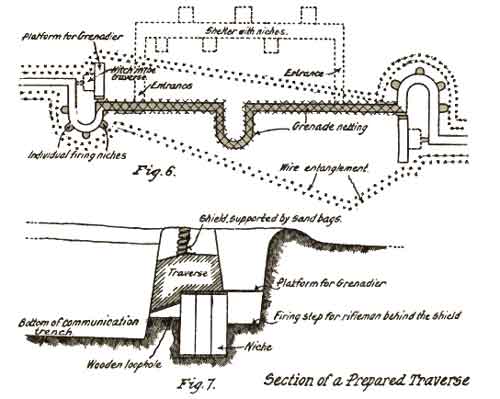
1. Niche in traverse for a rifle sweeping the bottom of the boyau and a rifle firing 1.4 meters above the ground. 2. Platform for grenadiers. 3. Niche with loopholes enfilading the auxiliary defenses. 4-5. Descents to shelter. 6. Traverse between two descents to avoid the same projectile striking both at the same time. 7. Wire entanglements. 8. Lattice against grenades.
The traverse blockhouses, with their covering of rails or cement, have the same degree of solidity as the dugout.
The second arrangement, formed as a redoubt around the dugout entrance, makes it easy for the occupants to get
out.
INTERIOR DEFENSE.
This defense can be assured by arrangement of obstacles, one behind the other, placed in the descents
themselves either at an intermediate or at the lowest point. The obstacle is made by enlarging the descent and
constructing a sandbag barrier at the desired position. As the obstacles interfere with the light, care must be taken
in lighting the descent.
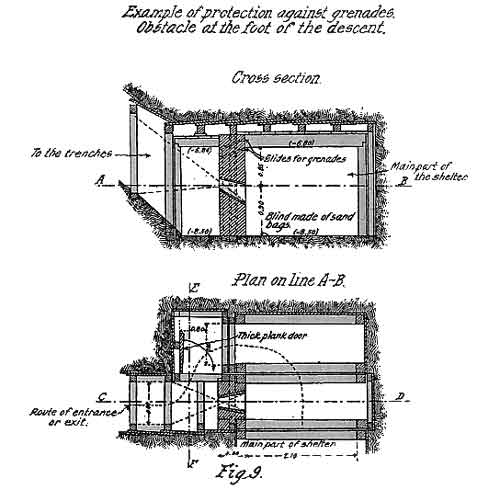
Protection against grenades. Protection against grenades must be added. The barrier of obstacles, one behind the
other, are not always able to keep the grenades from rolling into the main part of the dugout. One of the following
expedients may be employed:
	(1) A stationary panel with strong metal latticework is placed in front of the barrier in the descent. The
	panel is pulled up to the roof of the descent by means of a cord or wire whenever desired, or lowered
	so as to completely obstruct the descent.
	(2) Furnish the entrance of the obstacle with a heavy plank door. A landing place can also be built at
	the bottom of the descent, from which a short ramp leads up to the shelter. The grenade will then roll
	down to the landing place, but can not get up into the shelter. This arrangement is inconvenient, as
	the time and difficulty in constructing the dugout is considerably increased.
Protection against gas. Place cloths, impregnated with linseed oil or paraffin, or simply soaked in neutralizing solution
in the descent. The men's blankets are used if cloths are lacking. Each descent should be furnished with two
distinct cloths placed at intervals of 1 meter. This permits the descent to be hermetically closed to a sufficient
degree and at the same time allows passage. This arrangement is placed near the outlet to prevent the
accumulation of gas in the descent.
DETAILS OF THE WORK.
Frames. - For the descent - lining, 1-1/2 by 8/10 meters; ordinary, 1-1/2 by 1-6/10 meters or 7/10 by 8/10 meter;
inside dimensions. For the body of the shelter, 1-4/10 by 1-8/10 meters; diameter, 2/10 meter.
Roofing and lining planks. - One-twenty-fifth by eight-tenths by a variable width. The thickest are for the roof. Larger
frames are used for the commanders' accommodation, with an intermediate prop between the two uprights.
Slope for descent. - Lined frame, 1/1; ordinary frame, 7/10.
Working party for preparation of timber. - Five carpenters. Two for saw, two for rough squaring, and one for making
mortises. This working party can make three frames an hour, or even four with well-trained men. This working party
also cuts the lining planks and the wide battens. Tools: One large saw, one crosscut saw, two axes, one adze, one
carpenter's chisel, one mallet, one meter rule.carpenter's
Transportation of material. - Each working party carries enough supplies to complete their interval (timber casing and
lateral bracing).
Tools: Ordinary pick and shovel, short-handled pick and shovel. With each working party: One tenon saw, one
plumb line, one measuring tape, one hammer, one augur, one mason's level.
Removing earth: By means of sand bags or with small trucks on wooden rails, or with cases sliding on the floor of
the descent.
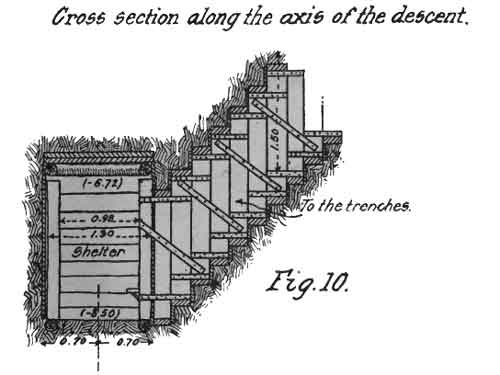
Progress of the work. - Working party : The two descents are begun simultaneously. When there are two working
parties they form in the middle of the shelter. With each working party there are four men to six meters in width, six
men to the shelters, and eight men to the main part of the shelter when it is commenced. A working party works for
8 hours and rests during 24. The entrance should be made in 2 days, and the descent at the rate of 2 meters a
day. The junction of the descents and the main part of the shelter should be made in 2 days. The shelter should be
dug at the rate of 2 meters a day. Each working party makes one complete interval, & by A meters, during its 8
hours, including timber casing. Fifteen days is required for 12 meters of descent and 15 meters of shelter.
End of Text
Return to Self-Reliance>>Self Defense>>Static (Area) Defense page.
Please Read The Website Disclaimer!
Copyright 1986-2012, The Survival & Self-Reliance Studies Institute (SSRsi), All
Rights Reserved
Site conceptualized, designed, created & maintained by MEG Raven
Snail Mail: SSRsi, PO Box 2572 Dillon, CO. 80435-2572