





















Direct Flame, using sugar and potassium permanganate (Condy's crystals).
Take about one teaspoonful of sugar, and about half this quantity of potassium permanganate and mix together,
and place in a shallow cut in a piece of dry wood. This hollow must be big enough to hold the whole of the dry
mixture. Round off a straight stick, about 1 to 1.5 mm thick and 300 mm long to a shallow point. Place this end of the
stick in the powder and rotate the stick rapidly between the two hands. The mixture will burst into a slow flame.
Several attempts may be necessary to obtain ignition. This method may not be effective in damp or cold weather.
Tinders and their Preparation
The principle required from tinder is that it must be readily combustible and finely
fibered. A simple test of natural, that is unprepared, tinder should be made to discover which materials are suitable.
To make the test, take a loosely teased handful of the material and place a coal from the fireplace into the material
and blow. If the fire from the coal extends to the tinder's it can be regarded as suitable.
Natural tinder's are generally found in dry, beaten grass, finely teased bark, and palm fiber. Most of these coarse
tinder's are improved in their ability to take and hold a spark by being beaten and pounded until the fibers are fine
and soft.
Natural fire-catching properties of tinder's can be improved by the addition of a light dusting of very finely ground
charcoal or, better still, being thoroughly scorched.
If saltpeter is available a little may be mixed with the charcoal before it is added to the tinder, or the tinder itself can
be soaked in a solution of saltpeter and water and allowed to dry before use.
Tinder impregnated with a solution of saltpeter and later dried must be carried in an airtight container. If carried
otherwise the saltpeter will become damp with moisture from the air. With this, or other prepared tinder's you always
have an emergency means of getting fire.
Old cotton or linen rag, scorched black and teased, is among the best of all tinder's. A pinch of this, placed where
the spark will fall, is certain to take the spark and quickly become a glowing coal.
Using these tinder's, lighting fire from spark is comparatively easy.
Striking a Spark
Flint and steel, of course, were the common method of lighting a fire before friction matches were perfected and no
great skill is needed for their use. The synthetic flint used in a cigarette lighter is a considerable improvement on
natural flint. A couple of pieces of synthetic flint pressed into a small piece of 'Perspex ' make an excellent
emergency fire lighting outfit (heat the Perspex and press the flint in while it is hot. Hold under cold water and the
Perspex will shrink on the flint and hold them securely).
An alternative to flint and steel are two pieces of iron pyrite, which, when struck together, throw off a shower of hot
sparks that will last for at least a second. Iron pyrite is a common crystalline formation, and not difficult to obtain.
Iron pyrite and steel will also give a hot spark. Quartz and steel, or two pieces of quartz, will also strike off good
sparks, but these latter stones are very much harder to use.
The sparks must fall on the tinder, which in turn, must be blown into a coal, and from the coal to a flame. Only a
pinch of tinder is required when you are proficient with striking a spark
Fire by Friction
Fire lighting by friction consists first generating a spark or tiny coal, and then nursing this (in tinder) to flame. Fire
lighting by friction is most easily mastered by the rotation of a drill or spindle in a foot piece. The drill, with some
native people is rotated between the hands but this requires considerable skill. Other primitive people rotated the
spindle by the means of a bow and thong. This is the easiest method. The component, which should be prepared
beforehand, are a bow, headpiece, drill and foot piece. The dimensions given below are a guide for size.
 |
To use a fire set, the drill is put
under the thong, and twisted so that the drill is on the
outer side of the thong, and with that portion of the thong nearest the handle of the bow on the upper side of the drill. This is important. This is how the thong must be round the drill. If the thong is wrong way on the drill it will cross over itself and cut in a few strokes, also the full length of the stroke cannot be obtained. |
 |
The foot piece has a shallow hole cut with a knife point into the upper side about half an inch from one edge. In this hole the drill is rotated. Into the edge of this hole from the nearest side, an undercut V is made. This should be at least 3 mm into the hole itself. |
 |
The underside of the headpiece has a shallow hole bored into it, and this is lubricated preferably with lead (graphite) from a pencil. A smear of fat will also serve as a lubricant, or if this is not obtainable, wax from the ear can be used. |
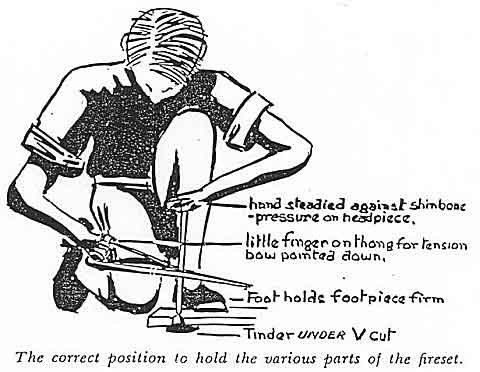
The correct body position for using the bow and drill is to kneel on the right knee, with the ball of the left foot on the
foot piece to hold it firmly to the ground. Place the lower end of the drill in the hole in the foot piece, and the top end
of the drill in the hole in the underside of the headpiece.
The left hand holds the headpiece. The wrist of the left hand must be braced against the shin of the left leg. This will
enable you to hold the headpiece perfectly steady.
To learn to use a firebow it is advisable to learn to rotate the drill slowly. This is done by drawing the bow backwards
and forwards. The thong round the drill will spin the drill. Only a light pressure is put on the headpiece. Very soon
you will see smoke coming from the foot piece, and notice that a fine brown powder is being ground out. This is
forming a dark ring round the edge of the hole. This powder is called "Punk". By examining it you can learn whether
the woods you are using are suitable for fire making.
The punk which will produce a glowing coal must feel slightly gritty when rubbed between the fingers, and then with
more pressure it should rub gradually to a silky smoothness as soft as face powder. This testing of the punk is
extremely important. If you do not know for certain that the woods you are using are suitable for fire lighting always
make this test first.
When you consider that you have mastered control of the bow and drill you can start trying to get fire. Place a
generous bundle of tinder under the V cut. When the drill is smoking freely and you have the punk grinding out
easily so that the V cut is full of it, put extra pressure on the headpiece and at the same time give twenty or thirty
faster strokes with the bow. Lift the drill cleanly and quickly from the foot piece. Fold some of the tinder over lightly
and blow gently into the V cut. If you see a blue thread of smoke continuing to rise, you can be sure you have a
coal. Fold the tinder completely over the foot piece, and continue blowing into the mass. The volume of smoke will
increase, and a few quick puffs will make it burst into flame.
A tip given by some authorities is to put a little charcoal or gritty material into the hole in the foot piece. The claim is
made that this enables more punk to be ground out, and the spark to be obtained more quickly. Suitable woods for
the foot piece and drill (the same wood should be used) include willows and some of the non-resinous pines.
Fire from a Magnifying Glass
Almost everyone at some tome or other has focused the sun's rays concentrated by a magnifying glass onto a
piece of paper or cloth to make it smoke. Lighting a fire with a magnifying glass calls for a ball of tinder with the
inner core of extra fine material. Onto this outer core the sun's rays are focused, and when the finer tinder is
smoking freely, it simply requires blowing to produce flame. A concave mirror is even better than a magnifying glass.
Powdered charcoal at the focal point will help the tinder to take more easily.
Please Read The Website
Disclaimer!
Copyright 1986-2012, The Survival & Self-Reliance Studies Institute (SSRsi), All
Rights Reserved
Site conceptualized, designed, created & maintained by MEG Raven
Snail Mail: SSRsi, PO Box 2572 Dillon, CO. 80435-2572